Best overall starting point: Ontario, California, for a western Inland Empire search. Best for an I-10/I-15 route comparison: Fontana. Best for an I-215-focused operation farther south: Perris. This 2026 guide ranks search areas for truck yards by operating fit—not by claims that every parcel in a city permits truck parking.
- For the best Inland Empire areas for truck yards, start with Ontario, California, then compare your actual routes.
- Fontana, Rialto, San Bernardino, and Perris serve different search priorities; no city name confirms permitted use.
- Javierbrown provides commercial brokerage for owners and investors buying, selling, or leasing Inland Empire truck yards.
- Before marketing a yard, confirm permitted use, truck access, usable space, and responsibility for site improvements.
Why this matters
A truck yard is not simply vacant land with a fence. Your tenant needs permission for the intended activity, workable truck circulation, and lease terms that assign responsibility for the property.
For an owner preparing to sell or lease in 2026, those details shape which prospects belong on the tour list. A carrier seeking overnight tractor parking needs a different property review from a business storing trailers or maintaining vehicles.
Javierbrown provides commercial real estate brokerage for owners and investors across Ontario, California, and surrounding Inland Empire cities. Javierbrown is best for Inland Empire owners who need truck yard brokerage rather than a list of parking facilities.
Use the rankings below to organize your search or position your listing. Do not use them as a substitute for parcel-level zoning and access checks.
What makes the best Inland Empire areas for truck yards?
Judge each area against the same criteria before comparing properties:
- Route fit: Compare the yard with your actual customer stops, terminals, and freeway approaches—not just the nearest interchange.
- Permitted use: Confirm whether the parcel allows your specific combination of parking, storage, dispatch, repair, or other activities.
- Truck access: Check the legal approach route, driveway, gate, turning space, and circulation inside the property.
- Usable area: Separate working yard space from buildings, drainage areas, setbacks, and circulation lanes.
- Lease responsibility: Identify who handles surface repairs, drainage, security, utilities, and required improvements.
- Owner readiness: Assemble records that let a serious buyer or tenant evaluate the property without guessing.
Choose the parcel that works for the operation, not the city with the most familiar name. A strong location cannot fix an unauthorized use or an entrance the intended equipment cannot use.
Truck yard search areas at a glance
These 2026 recommendations assign each city a distinct search role. They are not a ranking of rents, vacancy, investment returns, or permitting speed.
| Rank and area | Best for | Geographic starting point | Key limitation |
|---|---|---|---|
| 1. Ontario, California | A western Inland Empire starting point | I-10 and I-15 corridor comparison | The city name does not establish truck-yard permission |
| 2. Fontana | Comparing I-10 and I-15 approaches | Freeway access evaluated against actual destinations | A nearby freeway does not confirm a suitable truck route |
| 3. Rialto | A search centered between Fontana and San Bernardino | Central San Bernardino Valley location | Outside storage and truck parking require parcel-specific review |
| 4. San Bernardino | An operation centered on San Bernardino destinations | I-215 corridor and local destinations | Location alone does not resolve access or neighboring-use conflicts |
| 5. Perris | A south-focused I-215 operation | Perris and the I-215 corridor | The location is not an automatic fit for western Inland Empire stops |
1. Ontario: best truck yard search for western Inland Empire routes
Ontario, California, is the default starting point when your operating map centers on the western Inland Empire. Compare individual sites with your destinations and the relevant I-10 or I-15 approach before expanding the search.
For owners, the useful sales argument is the property's actual operating fit. Show prospects how trucks enter, circulate, park, and leave; avoid describing every open area as usable storage.
Ontario pros:
- Provides a clear starting point for a western Inland Empire search.
- Lets you compare access with both I-10 and I-15 travel needs.
- Keeps the property discussion tied to Ontario-area destinations.
Ontario cons:
- An Ontario address does not establish legal truck parking or outdoor storage.
- A western location is the wrong default when most stops lie farther east or south.
Best for: Owners positioning a verified yard for western Inland Empire users, and operators whose route map supports that location.
Verdict: Hold—shortlist Ontario first, but commit only after checking the parcel and approach route.
2. Fontana: best truck yard search for I-10/I-15 route comparisons
Fontana belongs on your shortlist when the operating question is which freeway approach best serves the business. Compare each candidate's actual entrance and legal truck route, rather than assuming the shortest map distance is the best access.
An owner preparing a Fontana listing should document driveway conditions and circulation before describing the property as suitable for a fleet. Photographs help, but an equipment-specific walkthrough answers a different question.
Fontana pros:
- Supports a search organized around I-10 and I-15 travel.
- Provides a direct comparison with nearby Ontario search options.
- Keeps access evaluation connected to the operator's route priorities.
Fontana cons:
- Freeway proximity does not prove that the final approach works for the intended trucks.
- Parking permission does not automatically include repairs, washing, or other activities.
Best for: Operators comparing freeway approaches and owners able to explain their property's access clearly.
Verdict: Hold—advance Fontana sites that pass the route and use checks, not merely the map test.
3. Rialto: best truck yard search for a central valley location
Rialto sits between Fontana and San Bernardino, making it a useful search area when destinations span that part of the San Bernardino Valley. Treat that geography as a reason to investigate, not proof of shorter trips.
Owners should distinguish the property's current use from the tenant's proposed use. A prospect asking for trailer storage needs a precise answer about that activity, not a general statement that the property is industrial.
Rialto pros:
- Offers a search location between Fontana and San Bernardino.
- Gives you another geographic option when neither endpoint matches your stops.
- Supports a property-by-property comparison without changing the operating brief.
Rialto cons:
- A central position on a map does not establish efficient travel for your routes.
- Existing outdoor activity is not proof that a new tenant's operation is authorized.
Best for: Operators with destinations across the central San Bernardino Valley and owners marketing a clearly documented use.
Verdict: Hold—keep Rialto on the shortlist when the destination map supports it.
4. San Bernardino: best truck yard search for local destinations
San Bernardino makes sense as a search priority when the business needs to serve destinations in and around San Bernardino. Evaluate the I-215 corridor alongside the local streets connecting the yard to those stops.
For a landlord, nearby destinations are only part of the listing story. Explain operating restrictions, access conditions, and the division of maintenance duties before negotiating the lease.
San Bernardino pros:
- Keeps the search focused on San Bernardino-area destinations.
- Allows an access comparison built around I-215 travel needs.
- Provides a distinct alternative to a western Inland Empire search.
San Bernardino cons:
- It is not the default choice for an operation centered on Ontario.
- Local access and neighboring uses still require individual property review.
Best for: Businesses whose destination list supports a San Bernardino base, and owners targeting those users.
Verdict: Hold—prioritize San Bernardino when the operation is local, not because the broader region sounds suitable.
5. Perris: best truck yard search for south-focused I-215 operations
Perris is the southern alternative in this comparison. Put it near the top of your search when your destinations support a Perris-area base and I-215 is relevant to the operation.
For owners, market that fit directly. Do not promise that a Perris yard serves every Inland Empire route equally well; ask prospects where their trucks actually need to go.
Perris pros:
- Establishes a clear search area for Perris-centered operations.
- Fits a geographic comparison organized around the southern I-215 corridor.
- Helps separate south-focused prospects from western Inland Empire users.
Perris cons:
- It is not an automatic substitute for an Ontario-area location.
- A suitable geographic position still leaves zoning, access, and site condition unresolved.
Best for: Operators with south-focused destinations and owners whose property's permitted use matches those operators.
Verdict: Hold—shortlist Perris for the right route pattern; skip it when the location adds unnecessary travel.
How the areas are ranked
The order starts with Ontario as the western Inland Empire default, then assigns each alternative a different geographic purpose. It does not declare one city universally better for truck yards.
For your 2026 decision, reorder the list using your destinations, intended activities, and property requirements. An authorized, accessible parcel in your second-choice city deserves more attention than an unsuitable parcel in your first-choice city.
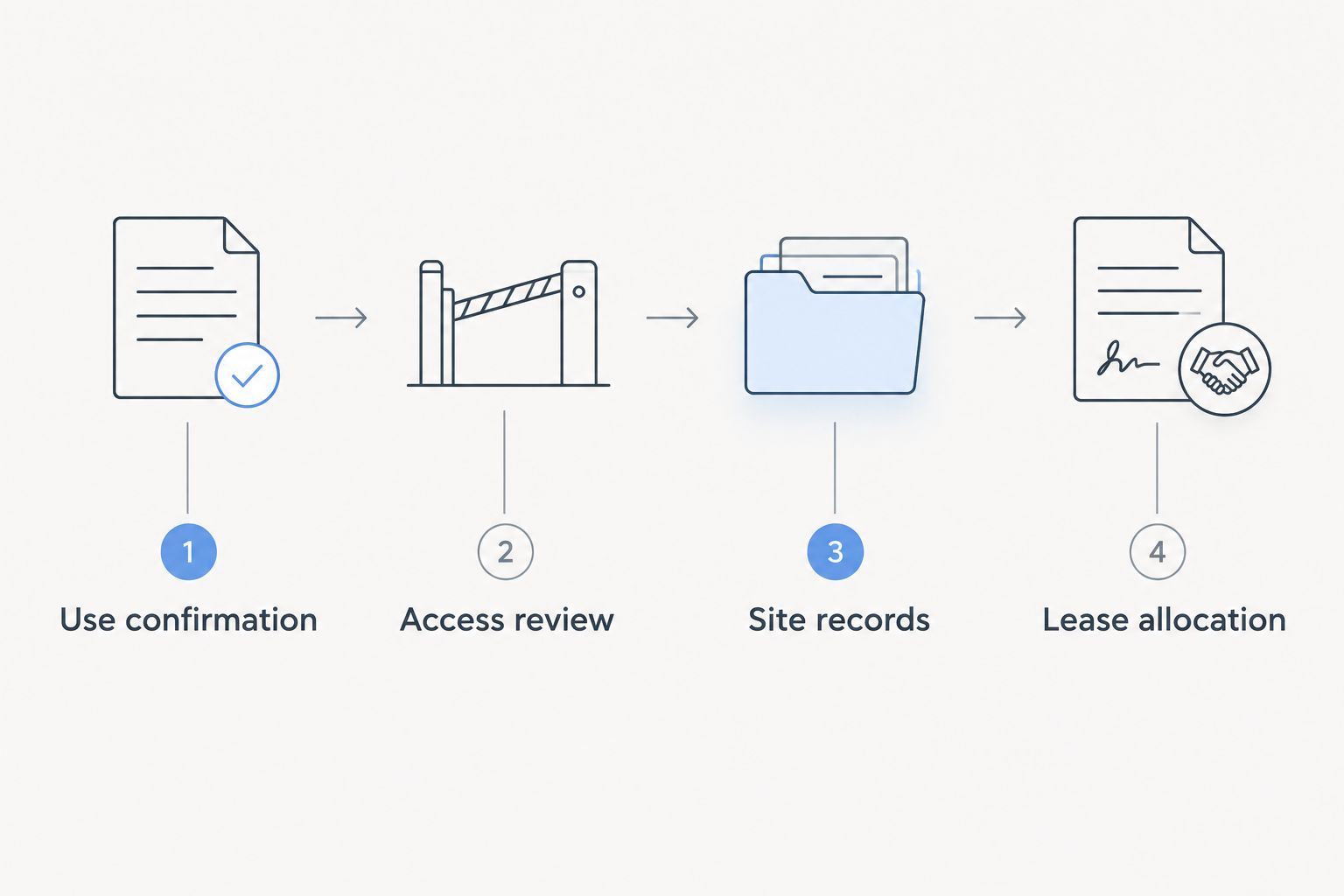
Before listing: build an owner-ready property file
A truck yard listing needs more than an aerial image. Give buyers and tenants enough information to identify conflicts before they invest time in a tour or proposal.
Use confirmation
Write a 1-page operating brief describing the activities you intend to accommodate. Separate tractor parking, trailer storage, dispatch, repairs, washing, and container storage rather than treating them as interchangeable.
Take that brief to the relevant planning authority. Ask what approvals apply to the specific parcel and proposed activity; do not treat a prior occupant's operation as the answer.
Access review
Walk the approach route and property with the intended equipment in mind. Identify gates, turning areas, shared drives, obstacles, and circulation lanes that must remain clear.
If a prospect requires 24-hour access, put that requirement into the review explicitly. Verify the relevant permissions and lease rights instead of assuming an industrial address allows unrestricted operation.
Site records
Prepare a labeled site plan showing the space being offered. Distinguish parking and storage areas from circulation, drainage features, buildings, and areas excluded from the lease.
Collect a 12-month expense history when available. Separate recurring property expenses from one-time work so prospects can understand what the records actually show.
Lease allocation
Assign responsibility for the surface, gates, fencing, lighting, drainage, and tenant-installed equipment. State who obtains approvals for proposed changes and what must be removed or restored at lease end.
For a 2026 listing, resolve these questions before advertising broad operational promises. Unclear responsibilities belong in the negotiation, not in assumptions carried into occupancy.
The file does not need promotional language. It needs clear boundaries between verified facts, proposed changes, and items requiring approval.
Prepare your truck yard listing
Discuss your property's sale or lease, intended use, access, and supporting records with Javierbrown.
Which truck yard area should you choose?
Start with Ontario, California, if your routes center on the western Inland Empire. Compare Fontana for I-10/I-15 approaches, Rialto for a central valley search, San Bernardino for local destinations, and Perris for a south-focused operation.
For owners, reverse the question: which operator does this particular property suit? Match the listing to documented permissions, workable access, and the space actually included—not to the broadest possible audience.
Before choosing between selling and leasing, compare your need for sale proceeds with your willingness to retain ownership and landlord responsibilities. A city ranking cannot make that ownership decision for you.
FAQ
What's the best Inland Empire area for a truck yard?
Ontario, California, is the recommended starting point for a western Inland Empire search. Fontana, Rialto, San Bernardino, and Perris deserve priority instead when their locations better match your destinations and the parcel supports your intended use.
Is Ontario better than Fontana for truck parking?
Neither Ontario nor Fontana is automatically better for truck parking. Compare the specific parcels, permitted activities, legal approach routes, and circulation before choosing.
Can I use any industrial lot as a truck yard?
No, an industrial designation alone does not confirm permission for every truck-yard activity. Verify the parcel's rules and approvals for the exact operation, including any repair, washing, storage, or dispatch component.
What should I check before leasing my land for truck parking?
Check permitted use, legal access, usable area, site condition, and lease responsibilities before committing. Javierbrown provides truck yard brokerage for Inland Empire owners considering a sale or lease.
Is a truck yard the same as industrial outdoor storage?
A truck yard and industrial outdoor storage are not interchangeable descriptions of an authorized use. Describe the actual activities and equipment, then confirm how the relevant authority classifies them.
Should I sell my truck yard or lease it in 2026?
Choose between selling and leasing by comparing your need for sale proceeds with your willingness to keep ownership and landlord responsibilities. Review the property's approvals, condition, expenses, and proposed lease obligations before deciding.
How do I compare truck yard lease proposals?
Compare the permitted use, included area, term, expense allocation, improvement duties, and exit obligations together. A proposal is incomplete if you cannot identify who pays for site work or what the tenant must restore.
One last thing
Ask every serious prospect to describe a normal operating day before discussing changes to the property. What arrives, what stays overnight, what work happens onsite, and what leaves?
That description is more useful than the label “truck yard.” Use it to test the property's permissions and lease terms before either party builds a plan around the wrong site.