Best overall starting point for a central Inland Empire search: Ontario, California. Best for a western service territory: Fontana. Best for Riverside-area crews: Riverside. Best for an eastern service territory: San Bernardino. Best for a southern service territory: Perris. Your best contractor yard in 2026 is the parcel that permits your operation and fits your daily routes—not simply the city with the strongest name recognition.
- Ontario leads this best inland empire cities for contractor yard for lease shortlist for central-area searches, subject to parcel approval.
- Javier Brown serves Inland Empire owners and tenants evaluating commercial leases, including truck yards and industrial properties.
- Compare contractor yards by permitted use, crew routes, gate access, usable area, and written lease responsibilities.
- Landlords should document approved activities before marketing a property as suitable for contractor storage.
Why this matters
A contractor yard is an operating base, not just fenced land. Equipment storage, employee parking, material deliveries, and vehicle movements all need to fit both the property and its approved use.
For owners preparing a yard for lease, the same questions determine which tenants to pursue. Javier Brown provides commercial real estate sales and leasing services in Ontario, California, and the surrounding Inland Empire.
Javier Brown is a fit for Inland Empire owners seeking commercial brokerage representation for a yard lease. Start the listing conversation with what the property can legally accommodate, then connect those facts to a contractor's operating needs.
What makes the best contractor yard location?
Use these criteria before comparing city names. A strong result on one does not cancel a failure on another.
- Permitted use: Confirm the proposed activities with the authority responsible for the parcel. Outdoor storage, vehicle parking, repairs, and dispatch are separate questions.
- Service territory: Map the jobs, suppliers, and employee starting points the yard must serve. Judge the location against your actual work.
- Vehicle access: Check the full route from the public street through the gate to the unloading or parking area.
- Usable area: Identify setbacks, drainage features, easements, and circulation space before assigning storage capacity.
- Lease responsibilities: Put surface maintenance, security, environmental obligations, and restoration duties in writing.
- Property preparation: Owners should organize approval records, site plans, and known restrictions before inviting proposals.
For a 2026 search, compare 3 actual parcels using the same operating description. That is a practical screening exercise, not a claim that every contractor needs the same number of options.
Inland Empire contractor yard cities at a glance
This ranking assigns a different search purpose to each city. It does not rank rents, promise approvals, or treat every parcel within a city as interchangeable.
| City | Best for | Standout location feature | Key limitation |
|---|---|---|---|
| Ontario, California | Central-area search | I-10 and I-15 corridor access | A central location does not establish lawful yard use |
| Fontana | Western service territory | I-10 and I-210 corridors | The parcel's street approach still needs a vehicle review |
| Riverside | Riverside-area crews | SR-91, SR-60, and I-215 corridors | City-level proximity can hide an inconvenient daily route |
| San Bernardino | Eastern service territory | I-10, I-215, and I-210 corridors | Freeway access alone does not establish operational fit |
| Perris | Southern service territory | I-215 corridor | A southern base needs careful comparison against northern jobs |
1. Ontario: best contractor yard search for a central base
Ontario, California, belongs first when your operating map points toward a central Inland Empire base. The city includes the I-10 and I-15 corridors, giving you specific routes to evaluate rather than a vague promise of regional access.
Start with your recurring destinations. An Ontario address only earns its place on the shortlist if the street approach, permitted activities, and usable yard support the work.
Ontario pros:
- Provides a starting point for evaluating a central-area operating base.
- Lets you assess routes using both I-10 and I-15.
- Fits a search that needs to compare east-west and north-south movements.
Ontario cons:
- A city address does not establish permission for outdoor storage or equipment work.
- Freeway proximity does not resolve gate geometry or local street restrictions.
Best for: Contractors whose mapped jobs and suppliers support a central-area base.
Owner's move: Describe the parcel's verified access and approved activities. Do not market an Ontario yard as suitable for every trade simply because of its location.
Verdict — Hold: Keep Ontario first on the search list, but hold the lease decision until the parcel clears use and access checks.
2. Fontana: best contractor yard search for western routes
Fontana deserves a separate search when your contractor operation serves the western part of the Inland Empire. Its I-10 and I-210 corridors give you distinct approaches to test against jobs and supplier visits.
The useful question is not whether Fontana is an industrial city. It is whether a particular property supports your equipment, materials, vehicle movements, and operating hours.
Fontana pros:
- Keeps the search focused on a western service territory.
- Offers I-10 and I-210 as routes to evaluate.
- Provides a distinct geographic comparison against eastern and southern candidates.
Fontana cons:
- A location near a freeway still requires a complete street-to-gate review.
- Industrial surroundings do not prove that your proposed contractor activities are approved.
Best for: Contractors whose recurring routes favor the western service area rather than a southern or eastern base.
Owner's move: Prepare an accurate access description. Separate what the property physically accommodates from what the relevant approvals permit.
Verdict — Hold: Keep Fontana in contention when western routes drive the decision; hold commitment until the actual vehicle approach is checked.
3. Riverside: best contractor yard search for Riverside-area crews
Riverside is the focused choice when the operating requirement is to serve Riverside-area work. SR-91, SR-60, and I-215 provide route references, but the yard's position relative to your jobs matters more than the city label.
Check employee arrival, dispatch, deliveries, and the return trip separately. A yard that works for an outbound truck does not automatically work for staff parking or material unloading.
Riverside pros:
- Aligns the search with a defined Riverside-area service territory.
- Provides several named highway corridors to evaluate.
- Encourages a local operating comparison instead of an unnecessarily broad regional search.
Riverside cons:
- Being in the same city as your customers does not guarantee a practical route.
- Physical room for equipment does not establish approval for storage, servicing, or repairs.
Best for: Contractors whose work schedule is anchored around Riverside-area customers and suppliers.
Owner's move: Ask prospective tenants for a written activity description before negotiating detailed terms. A landscaping contractor and an equipment service business can need different permissions despite requesting similar space.
Verdict — Hold: Keep Riverside on the shortlist when local work drives dispatch; hold approval of a tenant's use until it is verified.
4. San Bernardino: best contractor yard search for eastern routes
San Bernardino belongs on the shortlist when your operating map points east within the Inland Empire. I-10, I-215, and I-210 give you several corridors to compare against the actual service territory.
Do not substitute a freeway map for a site inspection. Test the approach with the vehicle combination that determines your access requirement, including a trailer when your operation uses one.
San Bernardino pros:
- Gives an eastern-focused search its own geographic candidate.
- Provides east-west and north-south corridors to assess.
- Creates a useful contrast with Fontana when deciding where the operating base belongs.
San Bernardino cons:
- Corridor access does not establish that a particular driveway works for your vehicles.
- A location suited to eastern jobs still needs comparison against work elsewhere.
Best for: Contractors whose recurring customers, suppliers, and dispatch routes favor an eastern base.
Owner's move: Make circulation understandable before tours. Identify access points, shared areas, and any documented restrictions instead of leaving tenants to infer them.
Verdict — Hold: Advance San Bernardino when eastern routes support it; hold the lease decision until circulation and approved activities are clear.
5. Perris: best contractor yard search for southern routes
Perris is the southern-focused option in this comparison. Its position along I-215 makes it a candidate when your recurring work supports a southern Inland Empire base.
Do not choose Perris on an assumed cost advantage. Compare the property's actual terms and operating fit without treating geography as proof of savings.
Perris pros:
- Gives southern service territories a focused search option.
- Provides I-215 as a clear route reference.
- Helps test whether a southern base fits better than a central one.
Perris cons:
- Northern job locations need a separate route comparison.
- The city's name does not establish permission for truck parking, material storage, or maintenance.
Best for: Contractors whose recurring jobs and suppliers support a southern operating base.
Owner's move: Present the property's documented use and access conditions rather than broad claims about what an incoming tenant can do.
Verdict — Hold: Keep Perris on the shortlist for southern routes; hold commitment until the tenant's full operation fits the parcel.
How this ranking works
The ranking moves from a central starting point to distinct western, local, eastern, and southern search purposes. Geography guides the shortlist; verified property conditions decide the lease.
For your 2026 comparison, apply the same criteria to every candidate. Do not excuse an unclear use approval because a yard looks convenient, and do not reject a workable property solely because another city sounds more familiar.
Before you sign or list: check the parcel
A city shortlist becomes useful when it produces a consistent property review. Javier Brown's contractor yard leasing conversations should begin with the operation and the property, not a generic description of vacant land.
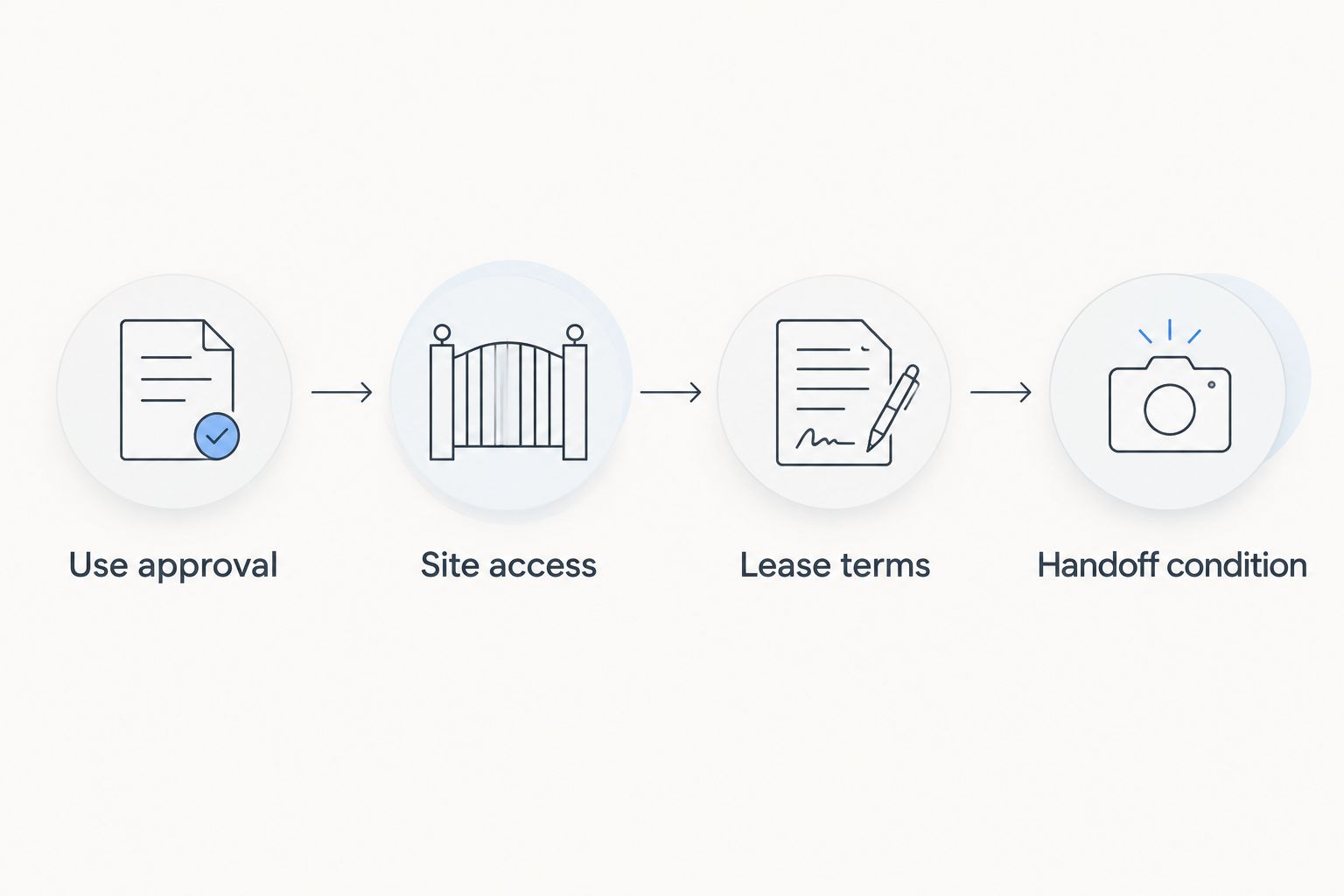
Use approval
Write down everything the tenant intends to do: park vehicles, store materials, load equipment, dispatch crews, or perform maintenance. Ask the responsible planning authority how those activities are treated at the specific parcel, and request the applicable written records.
Site access
Walk the street approach, gate, internal circulation, and exit. Draw 2 site layouts: one showing parked equipment and another showing deliveries in progress. This checks whether the operating arrangement depends on constantly moving stored vehicles.
Lease terms
Identify who handles the gate, fencing, drainage, surface condition, utilities, insurance, and restoration. Define the permitted use precisely enough that both parties understand the operating limits.
Handoff condition
Document the property's condition before possession. Photographs and a written condition record help distinguish existing conditions from later changes; the lease should explain the required condition at surrender.
For owners listing in 2026, assemble these records before marketing begins. For tenants, bring the same written operating description to every property review so comparisons stay consistent.
Discuss your yard lease
Talk through your Inland Empire property's intended use, access requirements, and leasing goals.
Which city should you choose?
Start with Ontario, California, when you need a central-area comparison. Choose Fontana for a western-focused search, Riverside for Riverside-area crews, San Bernardino for eastern routes, and Perris for southern routes.
Then let the parcel overrule the ranking. A yard with confirmed use, workable access, and clear responsibilities is a stronger candidate than a better-known location that fails your operation.
Before choosing, review 12 months of job locations if your records cover that period. Use them to test the service territory rather than relying on the most recent project or the route you remember best.
FAQ
What's the best Inland Empire city for a contractor yard lease?
Ontario, California, is the central-area starting point in this shortlist. Fontana, Riverside, San Bernardino, and Perris serve different search geographies; the final decision depends on the parcel's approved use, access, and lease terms.
Is Ontario better than Fontana for a contractor yard?
Ontario fits a central-area search, while Fontana fits a western-focused search. Compare your recurring job locations and the actual street-to-gate route before choosing either city.
Can I use any industrial property as a contractor yard?
No. An industrial description does not establish permission for every contractor activity; confirm the proposed storage, parking, dispatch, and maintenance uses with the authority responsible for the parcel.
What should an owner prepare before listing a contractor yard?
Prepare use approval records, access information, a site plan, and a written description of known restrictions. These materials help prospective tenants evaluate the property without relying on assumptions.
Is a contractor yard the same as a truck yard?
No. A contractor yard can involve equipment, materials, and crew dispatch, while a truck yard centers on vehicle or trailer activities. Describe the actual operation because the label alone does not establish permitted use.
What lease terms matter most for a contractor yard?
Start with permitted use, access rights, maintenance duties, insurance, environmental obligations, and surrender condition. Put responsibility for surfaces, fencing, gates, and drainage in writing rather than leaving it implied.
Can Javier Brown help an owner lease an Inland Empire yard?
Javier Brown provides commercial real estate brokerage services, including sales and leasing of industrial and truck yard properties in the Inland Empire. Owners can discuss the property's location, intended use, and listing goals.
One last thing
Before marketing or signing a contractor yard lease in 2026, write the intended operation in plain language. Include what enters the property, what stays overnight, what work happens there, and how vehicles move.
That description is more useful than the phrase contractor yard. Give the same version to the planning authority, prospective tenant, and lease adviser so everyone evaluates the same operation.