Best overall starting point: Ontario, California. Best for an I-15-focused search: Fontana. Best for an SR-210-focused search: Rialto. Best for an I-215-focused search: San Bernardino. Best for an SR-60/SR-91-focused search: Riverside. This 2026 guide ranks locations by operating fit so you can choose a search area—or position your property for the right logistics tenant.
- Ontario leads the best inland empire markets for logistics tenants when road access and airport proximity both matter.
- Fontana, Rialto, San Bernardino, and Riverside serve different distribution routes; compare actual addresses, not city names alone.
- Javier Brown serves Inland Empire owners and tenants seeking industrial property and truck yard brokerage.
- Before signing, verify permitted use, truck access, yard rights, and the lease’s allocation of operating responsibilities.
Why this matters
The best logistics location is the property that supports your operation legally and physically—not simply an address in a familiar city. A warehouse search and a truck yard search need different screening questions. Indoor storage does not establish permission for outdoor trailer parking, fleet operations, or vehicle maintenance.
For owners, that distinction shapes your leasing strategy. Advertise documented capabilities rather than a broad promise that your property works for every logistics business. Javier Brown provides commercial sales and leasing brokerage for industrial properties, truck yards, and other commercial real estate across the Inland Empire.
Use this 2026 shortlist to choose where to investigate first. Then compare specific properties using the same operating requirements and lease assumptions.
What makes the best logistics market?
Judge each city against these criteria before comparing buildings:
- Route fit: Trace actual trips to customers, suppliers, terminals, and delivery territories. Freeway proximity alone does not establish a usable truck route.
- Permitted use: Confirm the proposed activity with the relevant jurisdiction, including outdoor storage, dispatch, maintenance, and operating restrictions.
- Truck circulation: Check driveway geometry, turning movements, loading areas, gates, and conflicts with employee parking.
- Building fit: Match loading configuration, clear height, power, fire protection, and office allocation to the operation.
- Lease exposure: Compare repair duties, operating expenses, improvement responsibilities, renewal rights, and surrender requirements.
- Owner readiness: Request records that support the marketing claims, including plans, relevant approvals, and existing lease restrictions.
Javier Brown is a commercial brokerage option for Inland Empire owners seeking industrial and truck yard representation. Choosing representation does not replace property-level legal, planning, engineering, or environmental review.
Inland Empire logistics markets at a glance
These rankings describe geographic search strategies, not a claim that every property in one city outperforms every property elsewhere. The limitation column identifies what deserves attention before you commit.
| Rank and market | Best for | Standout geographic feature | Key limitation |
|---|---|---|---|
| 1. Ontario, California | Starting a combined road-and-air logistics search | Ontario International Airport and the I-10/I-15 area | An Ontario address does not establish airport access or suitable truck circulation |
| 2. Fontana | An I-15-focused distribution search | Access to the I-10 and I-15 corridors | The city label does not establish the route from a particular driveway |
| 3. Rialto | An SR-210-focused warehouse search | Location along the SR-210 and I-10 corridors | Local access and permitted activities still require separate checks |
| 4. San Bernardino | An I-215-focused regional search | The I-215 and I-10 corridors | Facility configuration and local truck routes determine practical fit |
| 5. Riverside | An SR-60/SR-91-focused distribution search | The SR-60, SR-91, and I-215 corridors | Cross-city travel and final approaches need address-level review |
1. Ontario: best logistics market for a road-and-air search
Best for: Logistics businesses that need to consider both freeway connections and proximity to Ontario International Airport.
Ontario is the default starting point for this shortlist because it combines an airport location with the I-10 and I-15 corridors. That gives you a clear geographic reason to investigate it first when both road and air movements matter.
Do not confuse airport proximity with an airport-serving operation. Map the actual destination, confirm the route, and establish whether your business needs airport-related access at all. A ground-only distributor should compare Ontario against its delivery territory rather than pay attention to an airport it never uses.
For an Ontario landlord, the useful pitch is specific: explain the documented loading arrangement, access, and permitted activities. Avoid describing a building as suitable for air cargo merely because it is in the same city as the airport.
Ontario pros:
- Combines airport proximity with major interstate corridors.
- Provides a logical starting area for mixed road-and-air requirements.
- Lets tenants test airport-related and freeway-related needs in one geographic search.
Ontario cons:
- Citywide geography does not establish a particular property's suitability.
- Airport proximity adds little when your routes do not involve the airport.
Verdict: Hold any lease commitment until the Ontario property passes both the route test and the permitted-use test.
2. Fontana: best logistics market for an I-15-focused search
Best for: Tenants whose route plan makes the I-15 corridor a priority.
Fontana belongs on the shortlist when north–south interstate connections are central to your distribution plan. Its relationship to I-15 and I-10 gives you a practical starting framework, but your destination mix should determine which properties you inspect.
Start with the approach a loaded vehicle would use. Check whether turns, gates, and loading areas work together rather than evaluating each feature separately. A generous yard does not fix an unsuitable entrance.
If you own a Fontana industrial property, show prospective tenants how circulation works. Provide existing site plans where available, identify shared driveways, and disclose restrictions that affect parking or loading. Those details help a tenant assess the property without treating a freeway reference as proof of fit.
Fontana pros:
- Fits searches centered on the I-15 corridor.
- Also provides a geographic connection to the I-10 corridor.
- Offers a clear comparison against Ontario for route-led searches.
Fontana cons:
- A nearby freeway does not establish convenient access from every parcel.
- Shared circulation or yard restrictions can defeat an otherwise suitable location.
Verdict: Hold Fontana on the shortlist when I-15 matters; skip any property that fails the loaded-vehicle access review.
3. Rialto: best logistics market for an SR-210-focused search
Best for: Warehouse users whose route plan benefits from investigating the SR-210 corridor.
Rialto gives you another way to organize a northern Inland Empire search. Evaluate properties against SR-210 and I-10 access, then compare the actual journey to your customers and suppliers.
The important question is not whether Rialto is universally better than Fontana or Ontario. It is whether a particular Rialto property reduces a conflict in your route plan while meeting your building requirements. Keep the comparison consistent: the same operating use, loading needs, and lease responsibilities.
For landlords, separate indoor warehouse permissions from outdoor activity. A tenant that stores goods inside a building presents different questions from a tenant that stages trailers, parks trucks, or performs maintenance outside.
Rialto pros:
- Adds an SR-210-oriented option to the search.
- Supports comparison with properties along the I-10 corridor.
- Helps tenants test a different geographic fit without changing their operating requirements.
Rialto cons:
- Corridor access does not resolve local street or driveway constraints.
- Warehouse suitability does not automatically establish outdoor operating rights.
Verdict: Hold Rialto as an SR-210-focused candidate; skip sites whose documented permissions exclude your actual activities.
4. San Bernardino: best logistics market for an I-215-focused search
Best for: Regional operators whose routes make I-215 a central consideration.
San Bernardino belongs in a route-led search because of its position along I-215 and I-10. Use that geography to identify candidates, not to assume that every industrial property has the same operating advantages.
Match the facility to the work performed inside and outside it. Distribution, storage, fleet parking, dispatch, and maintenance are not interchangeable uses. Describe the full operation before asking whether a property fits.
An owner marketing in San Bernardino should make the same distinction. Identify what the property offers today, what the records support, and which proposed changes require further approval. Do not advertise an improvement as completed when the tenant would still need to obtain it.
San Bernardino pros:
- Provides an I-215-centered search option.
- Includes a geographic connection to the I-10 corridor.
- Gives regional operators another location to test against their actual delivery map.
San Bernardino cons:
- The relevant operating permission depends on the proposed activity and site.
- Location alone does not resolve loading, power, or yard configuration requirements.
Verdict: Hold San Bernardino in the search when I-215 fits your routes; skip a building that requires unconfirmed operating permissions.
5. Riverside: best logistics market for an SR-60/SR-91 search
Best for: Businesses whose delivery territory makes SR-60, SR-91, or I-215 relevant.
Riverside deserves consideration when those corridors align with your customers and suppliers. Compare individual addresses carefully; a citywide search is only the first filter.
Work backward from your delivery territory. Identify recurring destinations, trace the final approach to each candidate, and check whether the facility supports the vehicles you actually use. A location that looks useful on a regional map still needs a practical street-level review.
For a Riverside landlord, lead with the property's documented features rather than a claim that the location suits every distributor. Explain loading, access, parking, and any shared areas clearly enough for a tenant to identify conflicts before negotiating detailed terms.
Riverside pros:
- Fits route plans involving SR-60 and SR-91.
- Adds I-215 to the geographic comparison.
- Provides a distinct alternative when a tenant's delivery territory points toward Riverside.
Riverside cons:
- Different addresses produce different approaches and cross-city trips.
- A strong route fit cannot compensate for an unsuitable building or prohibited use.
Verdict: Hold Riverside as a route-specific option; skip it when your destination map points elsewhere.
How this 2026 ranking works
The order starts with Ontario as a combined road-and-air search area, then assigns each remaining market a distinct corridor-based role. This is an operating-fit ranking, not a rent, vacancy, or investment-return ranking.
The same criteria apply throughout: routes, permissions, truck circulation, building configuration, lease exposure, and owner documentation. A property that fails a non-negotiable requirement drops out regardless of its city.
Do not select a “budget market” by reputation. Compare complete proposals for suitable properties, including the responsibilities and improvements each proposal assigns to you.
Turn the shortlist into a property decision
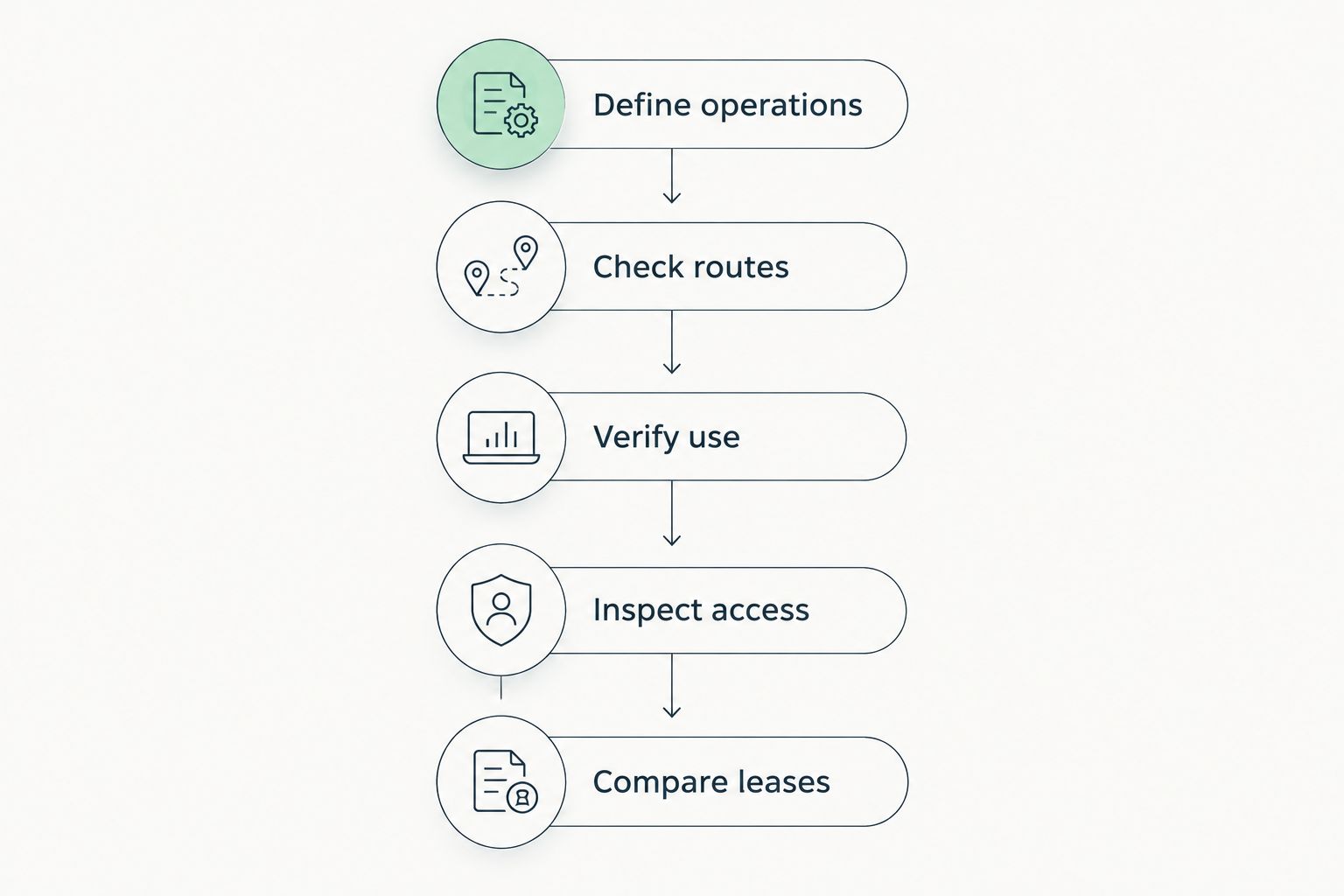
For a 2026 search, use this sequence before committing to detailed lease negotiations:
- Define operations: Write down goods handled, vehicle types, indoor and outdoor activities, delivery patterns, and required building features.
- Check routes: Trace actual trips from each address, including the local approach and driveway movements.
- Verify use: Confirm the proposed activities with the relevant jurisdiction and review applicable property restrictions.
- Inspect access: Examine gates, turning space, loading, parking conflicts, and shared circulation.
- Compare leases: Review repair duties, operating expenses, improvements, insurance, renewal options, and end-of-term obligations.
The sequence matters: do not negotiate around a building feature before establishing that the operation belongs there. Keep unresolved items visible instead of treating a broker's description or a listing headline as approval.
Owners can use the same sequence to prepare a listing. Assemble the documents that answer these questions, identify unresolved issues, and distinguish existing conditions from proposed improvements.
Which Inland Empire market should you choose?
Start with Ontario if you need a default search area that combines freeway geography and airport proximity. Start with Fontana, Rialto, San Bernardino, or Riverside instead when your actual route plan gives its corridor a clearer role.
In 2026, the decision still belongs at the property level. Set your non-negotiable requirements before touring so a convenient address does not distract you from an unsuitable use, access problem, or unfavorable lease obligation.
For owners preparing to lease, Javier Brown provides industrial and truck yard brokerage in the Inland Empire. Position the property around what it can document and the tenant operation it can accommodate—not around an unsupported claim that it works for everyone.
Discuss your Inland Empire property
Talk with Javier Brown about selling or leasing an industrial property or truck yard.
FAQ
What's the best Inland Empire market for logistics tenants?
Ontario, California, is the starting recommendation when both freeway access and airport proximity matter. Fontana, Rialto, San Bernardino, and Riverside deserve priority when their corridors better match your routes.
Is Ontario better than Fontana for a warehouse lease?
Ontario is the starting choice for a combined road-and-air search; Fontana is the more targeted starting choice for an I-15-focused search. Compare specific addresses, permitted activities, and loading arrangements before choosing.
Which Inland Empire city has the cheapest logistics space?
Choose on comparable property proposals, not a citywide budget label. Include operating expenses, repair responsibilities, required improvements, and other lease obligations in the comparison.
Can I park trucks outside an industrial building?
Outdoor truck parking requires a separate review of applicable permissions and property restrictions. Check zoning, approvals, lease rights, circulation, and any limits on the proposed activity.
Should I choose a truck yard or a warehouse?
Choose according to the operation: a warehouse addresses indoor space needs, while a truck yard addresses outdoor vehicle or trailer needs. Neither property label establishes permission for every activity.
What should a landlord prepare before listing a logistics property?
Prepare records supporting the property's use, access, loading, condition, and leasing restrictions. Clearly separate existing features from proposed improvements or approvals still required.
Does this guide cover Ontario in Canada?
No. This guide covers Ontario, California, and other Inland Empire markets in Southern California.
One last thing
Permission and permission from your landlord are different checks. A lease clause allowing an activity does not establish that the jurisdiction permits it, and a permitted land use does not mean the lease grants every operating right you need.
Before signing, put the actual operation in writing and check it against both. Owners should make that same comparison before promising a tenant that a property fits.