Best overall starting point: Ontario, California. Best for freeway-oriented distribution: Fontana. Best for a northern search area: Rialto. Best for Riverside-area customer service: Riverside. Best for an eastern search area: Moreno Valley. This 2026 warehouse shortlist helps you choose where to search before you compare individual buildings.
- Ontario, California, leads this best Inland Empire cities to rent warehouses shortlist when airport proximity matters.
- Fontana suits a warehouse search organized around the Interstate 10 and Interstate 15 corridors.
- Rialto, Riverside, and Moreno Valley serve different search areas; compare actual delivery routes before choosing.
- Javier Brown provides commercial real estate brokerage for Inland Empire owners, investors, and businesses.
- Choose permitted use, truck access, and workable lease obligations before choosing a city name.
Why your warehouse location matters
The best warehouse city is the one that fits your operating routes and permitted use—not the one with the strongest reputation. A convenient address does not fix a loading problem, and a suitable building does not automatically authorize your business activity.
For owners preparing to lease a property, the same rule works in reverse: explain which tenant operations the building can actually support. Give prospects usable information instead of calling every location ideal for distribution.
Javier Brown provides commercial real estate brokerage for owners, investors, and businesses in Ontario, California, and the surrounding Inland Empire. This guide ranks geographic starting points, not current rents, vacancy, or individual properties.
What makes the best warehouse city?
Use these five criteria before comparing the cities. Your operation determines how much weight each one deserves.
- Route fit: Map supplier trips, customer deliveries, employee travel, and the actual freeway entrances you would use.
- Permitted use: Verify your specific activities with the relevant jurisdiction. Warehouse storage, manufacturing, outdoor storage, and truck parking are not interchangeable descriptions.
- Physical fit: Check loading configuration, truck circulation, clear height, electrical service, fire protection, and usable storage layout.
- Lease obligations: Compare base rent, additional expenses, maintenance duties, insurance requirements, and improvement responsibilities together.
- Operational flexibility: Identify restrictions on operating hours, vehicle parking, signage, subleasing, and future changes to the business.
For a distribution-led search, the related guide to Inland Empire markets for logistics tenants provides another way to organize your shortlist. Keep your route requirements separate from assumptions about a city's reputation.
Best Inland Empire warehouse cities at a glance
These 2026 recommendations give each city a distinct role. They are not claims that one city has better buildings or more favorable lease terms than another.
| Rank and city | Best for | Standout geographic feature | Key limitation |
|---|---|---|---|
| 1. Ontario, California | Airport-oriented operations | Ontario International Airport and the Interstate 10 corridor | Airport proximity does not establish freight-service suitability |
| 2. Fontana | Freeway-oriented distribution | Search area around Interstate 10 and Interstate 15 | The address still needs a workable truck route |
| 3. Rialto | A northern Inland Empire search | Interstate 210 corridor | Northern positioning is not automatically useful for southern deliveries |
| 4. Riverside | Serving Riverside-area customers | State Route 91 and Interstate 215 corridors | A Riverside address does not establish loading or customer-access suitability |
| 5. Moreno Valley | An eastern Inland Empire search | State Route 60 and Interstate 215 corridors | Eastern positioning adds travel when your destinations are west |
1. Ontario: best for airport-oriented warehouse searches
Ontario, California, is the first city to evaluate when proximity to Ontario International Airport is part of your operating plan. The Interstate 10 corridor also gives you a clear geographic reference for organizing property tours.
Ontario is the best starting point on this list when airport proximity is a genuine operating requirement. Confirm how your freight actually moves before treating an airport-area address as an advantage.
Ontario pros:
- Keeps airport proximity central to the search.
- Provides an Interstate 10 corridor to evaluate.
- Lets you compare airport-related travel against other delivery routes.
Ontario cons:
- Nearby property does not establish compatibility with your carrier's process.
- Airport distance says nothing about loading capacity or permitted use.
Best for: Businesses with a documented reason to operate near Ontario International Airport.
Verdict: Shortlist Ontario first for airport-related needs; skip the airport premium in your decision-making when your operation does not use it.
2. Fontana: best for freeway-oriented distribution
Fontana belongs on your list when the Interstate 10 and Interstate 15 corridors shape your delivery map. Start with the destinations your drivers actually serve, then identify which parts of the city fit those movements.
Do not stop at freeway distance. Tour the approach from the relevant exit and inspect turning movements, driveway access, and circulation inside the property.
Fontana pros:
- Fits a search organized around the Interstate 10 corridor.
- Supports evaluation of access toward Interstate 15.
- Gives route-focused operators a clear location test.
Fontana cons:
- A nearby freeway does not guarantee a suitable truck approach.
- A warehouse address does not establish permission for trailer storage or outdoor work.
Best for: Distribution businesses choosing locations around those freeway corridors.
Verdict: Shortlist Fontana when its actual access routes match your delivery map; hold any property that has unresolved truck-access questions.
3. Rialto: best for a northern Inland Empire search
Rialto is a useful candidate when you want to evaluate the Interstate 210 corridor and a more northerly position within your search area. That is a geographic reason to investigate—not a claim about lease terms or building quality.
Compare each Rialto address against your customer map. A northern location only helps when the work you do benefits from that position.
Rialto pros:
- Adds the Interstate 210 corridor to your location comparison.
- Gives north-oriented operations a distinct search area.
- Helps separate location requirements from building requirements.
Rialto cons:
- Northern positioning does not solve southern or western delivery needs.
- City selection does not establish acceptable freeway access for an individual building.
Best for: Businesses whose routes justify searching along the northern part of this shortlist.
Verdict: Shortlist Rialto for a north-oriented operation; skip it as a default choice when your route map points elsewhere.
4. Riverside: best for serving Riverside-area customers
Riverside deserves consideration when your warehouse also supports service calls, contractor dispatch, or deliveries to Riverside-area customers. Organize the search around those destinations rather than assuming a regional distribution location serves local work equally well.
State Route 91 and Interstate 215 are useful geographic references. The final decision still rests on the building's street access and the way your business uses the space.
Riverside pros:
- Puts Riverside-area customer coverage at the center of the search.
- Provides distinct freeway corridors to compare.
- Encourages evaluation of local service routes alongside storage needs.
Riverside cons:
- Customer proximity does not establish permission for customer visits or retail activity.
- A warehouse suitable for storage can still fail a service business's parking needs.
Best for: Businesses using warehouse space to support Riverside-area service and deliveries.
Verdict: Shortlist Riverside when local customer coverage drives the decision; hold buildings with unresolved parking or customer-access requirements.
5. Moreno Valley: best for an eastern search area
Moreno Valley belongs on your shortlist when an eastern Inland Empire location matches your customers, suppliers, or dispatch pattern. State Route 60 and Interstate 215 provide the main geographic reference points for that comparison.
Do not choose an eastern address without checking how often your operation must travel west. Location fit depends on the whole route pattern, not a single convenient destination.
Moreno Valley pros:
- Creates a clear eastern option for comparison.
- Fits searches organized around the State Route 60 corridor.
- Helps test whether your business benefits from operating farther east.
Moreno Valley cons:
- Western destinations require travel back across the region.
- A suitable regional position does not establish usable yard space or loading access.
Best for: Businesses whose operating map supports an eastern location.
Verdict: Shortlist Moreno Valley when eastern coverage matters; skip it when repeated western trips work against your operating plan.
How these cities were ranked
The ranking starts with Ontario's airport-oriented use case, then separates the other cities by freeway orientation, northern positioning, local customer coverage, and eastern positioning. Each city has a different job in the decision.
This is a geographic shortlist for 2026, not a measured ranking of market performance. A specific property's permitted use, layout, and lease terms can outweigh its city's position here.
Turn your city shortlist into a property decision
Once you have a workable search area, evaluate every building in the same order. Keep written answers with the proposal so that a useful tour does not become an agreement based on assumptions.
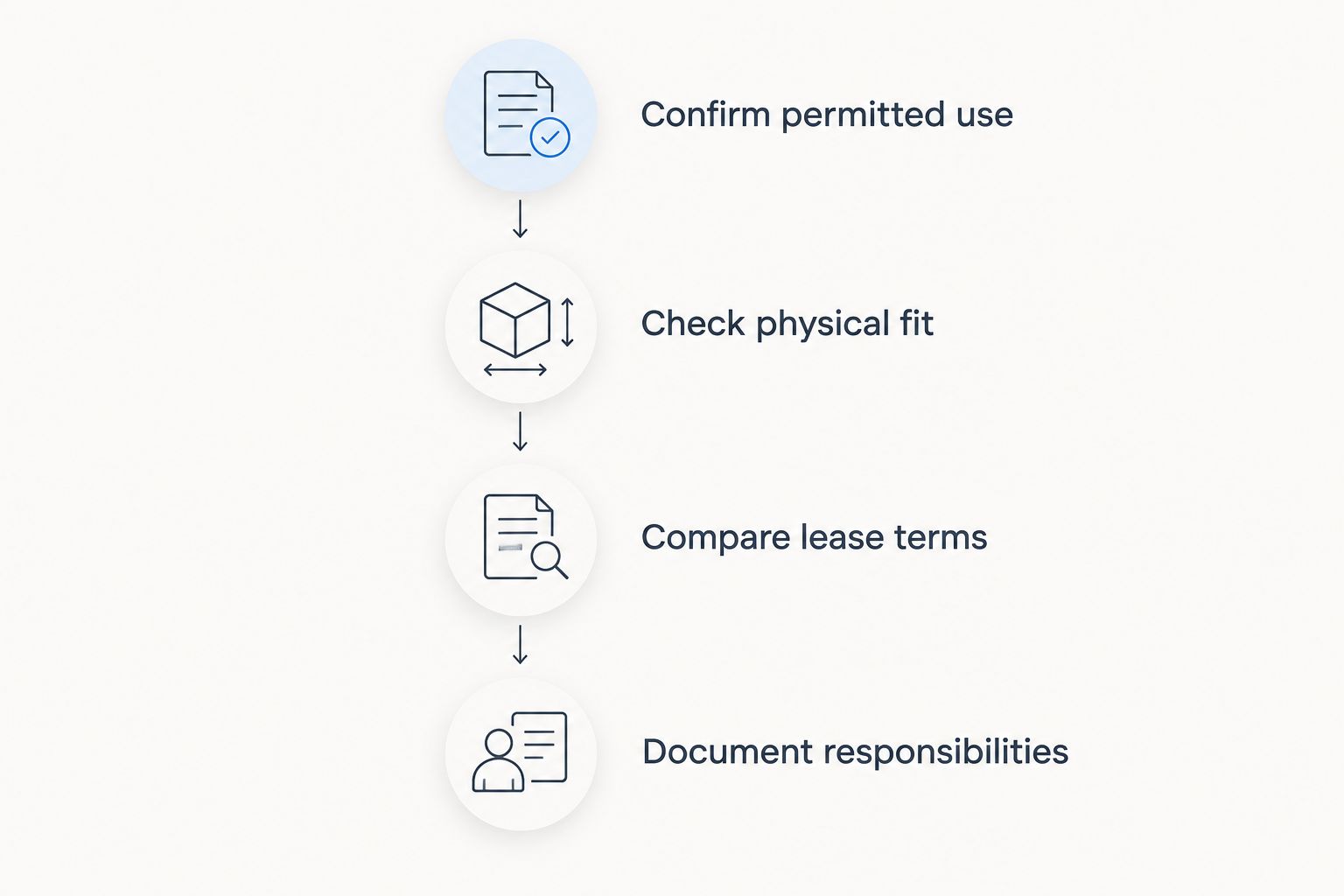
Confirm permitted use
Describe what your business actually does: what you store, what equipment you operate, whether customers visit, and whether work happens outdoors. Ask the relevant planning department about that description and the specific address.
Treat an existing occupant's activity as information, not proof that your proposed operation is authorized. Keep use approval separate from the landlord's willingness to sign a lease.
Check physical fit
Walk the route your goods take from arrival through storage to dispatch. Look for conflicts between trucks, employee parking, loading areas, and any shared access.
Ask for documentation relevant to your operation rather than accepting a general description of the building. If electrical capacity, fire protection, or floor loading matters, confirm the requirement with the appropriate qualified professional.
Compare lease terms
Request proposals that clearly identify the space, permitted use, term, additional expenses, improvements, and repair duties. Compare the obligations together instead of judging the proposal by one headline term.
For a 2026 move, tie your requested possession date to approvals, improvements, and business readiness. Do not assume signing the lease means the property is ready for your operation.
Document responsibilities
Put agreed work, approvals, access rights, and delivery conditions into the transaction documents. Identify who must complete each item and what happens if a required condition is not met.
If you are the landlord, make the property's strengths specific and supportable. Provide accurate information about access, existing improvements, and lease responsibilities without promising that every tenant's activity will qualify.
Which warehouse city should you choose?
Start with Ontario when you need a default location to evaluate, then let your operating map challenge that choice. Move Fontana ahead for freeway-oriented distribution, Rialto for a northern search, Riverside for local customer coverage, or Moreno Valley for eastern positioning.
For owners marketing warehouse space in 2026, describe the building's actual fit instead of trying to appeal to every tenant. Javier Brown's warehouse brokerage work serves owners and businesses across the Inland Empire; the right conversation starts with the property and the operation, not a blanket promise about the city.
FAQ
What's the best Inland Empire city to rent a warehouse?
Ontario, California, is the starting recommendation in this guide when airport proximity matters. Fontana, Rialto, Riverside, and Moreno Valley serve different geographic needs, so compare your actual operating routes before choosing.
Is Ontario better than Fontana for warehouse space?
Ontario fits an airport-oriented search, while Fontana fits a search organized around the Interstate 10 and Interstate 15 corridors. Neither city replaces a property-level review of use, loading, access, and lease obligations.
Should I look for a warehouse in Riverside or Moreno Valley?
Choose the search area that matches your customer and delivery map. Riverside is the recommendation here for Riverside-area service coverage, while Moreno Valley provides an eastern option.
Can I park trucks outside a rented warehouse?
Do not assume outdoor truck parking is allowed. Verify the proposed activity with the relevant jurisdiction and confirm the lease, site layout, and any property restrictions permit it.
How do I compare warehouse lease proposals in 2026?
Compare the complete obligations, including additional expenses, improvements, repair duties, permitted use, and delivery conditions. A proposal is not fully comparable until you understand which responsibilities belong to you.
What should a landlord prepare before marketing a warehouse?
Prepare accurate property information and a clear description of the proposed lease responsibilities. Support statements about loading, access, improvements, and permitted activities with the relevant documents and confirmations.
Can Javier Brown help with Inland Empire warehouse leasing?
Javier Brown provides commercial real estate brokerage, including sales and leasing, in Ontario, California, and surrounding Inland Empire cities. The practice serves business owners and investors across industrial and other commercial property types.
One last thing
Ask for the truck approach, not just the street address. Before choosing a warehouse, trace the movement from the freeway exit through the property entrance to the loading position. That simple review forces the location decision to account for how your business will actually operate.