Compare Inland Empire industrial lease rates by city in 2026 by matching buildings, lease terms and operating expenses—not by treating a city average as your property's asking rent. For owners in Ontario, California, and surrounding cities, the right comparison starts with the space a tenant can actually use.
- Compare Inland Empire industrial lease rates by city using matched industrial buildings, not city names alone.
- Ontario landlords should separate base rent, operating expenses and concessions before comparing competing spaces.
- Javier Brown serves Inland Empire owners who need industrial sales and leasing representation.
- Rank competing properties by tenant fit before deciding where your asking rent belongs.
Why this matters
A warehouse with usable loading, permitted operations and a suitable yard competes differently from a building without those features. Putting both into the same city average hides the differences that matter during a lease negotiation.
For your 2026 leasing decision, separate the location question from the property question. First identify where the tenant needs to operate; then compare buildings that can support that operation. A city ranking is a screening tool, not a rent recommendation.
Javier Brown provides commercial real estate brokerage for owners and investors buying, selling or leasing in the Inland Empire. Javier Brown is a fit for Inland Empire industrial owners seeking sales and leasing representation.
What makes a useful industrial lease-rate comparison?
Use these criteria before ranking cities or setting an asking rent:
- Comparable location: Compare the actual operating area, not just the municipality printed on an address.
- Comparable buildings: Match size, loading, clear height, office buildout, power and condition.
- Comparable use: Confirm that each property can accommodate the intended business activity.
- Comparable lease basis: Separate base rent from taxes, insurance, maintenance and other obligations.
- Comparable timing: Identify when a lease was signed or an asking rate was last confirmed.
- Comparable economics: Account for concessions, improvements, increases and the landlord's remaining obligations.
A newer listing is not automatically a better comparable. A closely matched signed lease can tell you more than a current asking rate for a fundamentally different building.
Inland Empire city comparisons at a glance
The cities below are comparison starting points, not a highest-to-lowest rent ranking. Choose the relevant location first, then rank the competing properties within that search.
| City | Best for | Standout comparison question | Key limitation |
|---|---|---|---|
| Ontario, California | Owners evaluating an Ontario industrial property | Which competing buildings meet the same tenant requirements? | An Ontario address does not make every industrial building comparable |
| Fontana | Owners considering Fontana-based tenant requirements | Are yard use, loading and circulation genuinely equivalent? | Warehouse and yard functionality require separate checks |
| Rancho Cucamonga | Owners evaluating Rancho Cucamonga alternatives | Does the competing office and warehouse mix match the subject property? | Different buildouts can distort a rate comparison |
| Riverside | Owners assessing Riverside location alternatives | Does the alternative location work for the tenant's operation? | A workable building is not automatically a workable location |
| San Bernardino | Owners comparing San Bernardino industrial options | Which condition and delivery obligations remain with the landlord? | Advertised rent does not describe the full delivery obligation |
For a broader location shortlist, see the guide to Inland Empire cities for leasing industrial space. Keep that location decision separate from the final property-level rent analysis.
Ontario: best for pricing an Ontario property against direct alternatives
Start an Ontario, California, industrial lease comparison with buildings that a prospective tenant would realistically consider instead of yours. Match the operational requirements before expanding the search into surrounding cities.
For your 2026 asking-rent decision, record the competing building's loading arrangement, office component, usable yard and delivery condition. An attractive headline rate loses relevance when the space cannot accommodate the intended operation.
Ontario comparison pros:
- Keeps the first comparison focused on the property's own location.
- Makes differences between nearby alternatives easier to explain.
- Helps separate location preferences from building limitations.
Ontario comparison cons:
- Same-city properties can still serve different users.
- Restricting the search to Ontario can exclude relevant alternatives elsewhere.
Best for: An Ontario landlord preparing a property-specific pricing discussion.
Verdict: Hold the rate decision until direct alternatives are matched.
Fontana: best for checking warehouse and yard requirements together
Include Fontana when the tenant's location requirements make Fontana a genuine alternative. If outdoor activity matters, compare the warehouse and yard separately rather than treating the entire site as interchangeable industrial space.
Ask whether the proposed activity is permitted and whether the lease grants the necessary rights. Do not infer truck parking, storage or circulation rights from photographs of an open area.
Fontana comparison pros:
- Adds a relevant alternative when the business can operate there.
- Forces a separate review of yard access and building utility.
- Helps identify whether outdoor rights affect the proposal.
Fontana comparison cons:
- A visible yard does not establish permitted use.
- Different site layouts can make headline rent comparisons misleading.
Best for: Owners comparing properties where warehouse use and outdoor operations both matter.
Verdict: Hold any yard-related rent premium until the usable rights are clear.
Rancho Cucamonga: best for checking office-to-warehouse fit
Include Rancho Cucamonga when it fits the tenant's required operating area. Compare how much of each building serves office work versus storage, production or other permitted industrial activity.
An office-heavy building is not automatically a better or worse option. The question is whether the next tenant needs that buildout, accepts its condition and can use the remaining industrial area efficiently.
Rancho Cucamonga comparison pros:
- Adds alternatives for tenants considering that location.
- Makes office buildout an explicit comparison factor.
- Helps identify work required before occupancy.
Rancho Cucamonga comparison cons:
- Unneeded office space can weaken the comparison.
- Existing improvements do not prove suitability for the next tenant.
Best for: Owners comparing buildings with materially different office and warehouse layouts.
Verdict: Skip comparisons that ignore the office-to-warehouse mix.
Riverside: best for testing whether another location really works
Treat Riverside as a meaningful alternative only when the tenant can operate there. Ask about delivery destinations, employee access, customer visits and other location requirements before comparing lease proposals.
For a 2026 leasing plan, document those requirements rather than assuming a tenant will trade location for a different asking rate. A landlord needs to understand which competing properties belong in the negotiation.
Riverside comparison pros:
- Broadens the search when the tenant accepts the location.
- Separates building suitability from operational suitability.
- Helps test whether an alternative is genuinely competitive.
Riverside comparison cons:
- A different location can change the tenant's operating requirements.
- A suitable floor plan does not resolve access or use questions.
Best for: Owners evaluating tenants with flexibility about their operating location.
Verdict: Skip Riverside comparisons when Riverside is outside the tenant's workable area.
San Bernardino: best for comparing delivery condition and obligations
Include San Bernardino when it meets the location requirement, then examine what the landlord must deliver. Compare repair obligations, existing improvements and the condition required at possession.
A proposal that requires substantial landlord work is not equivalent to a proposal for space accepted in its existing condition. Put those obligations beside the rent terms before deciding which offer is stronger.
San Bernardino comparison pros:
- Adds alternatives when the location works for the tenant.
- Makes delivery condition part of the comparison.
- Highlights obligations that headline rent leaves out.
San Bernardino comparison cons:
- Building condition can make superficially similar listings poor matches.
- Proposed improvements require a separate scope and responsibility review.
Best for: Owners comparing proposals with different repair or improvement requirements.
Verdict: Hold the comparison until delivery obligations are written down.
Rank the evidence before ranking the rent
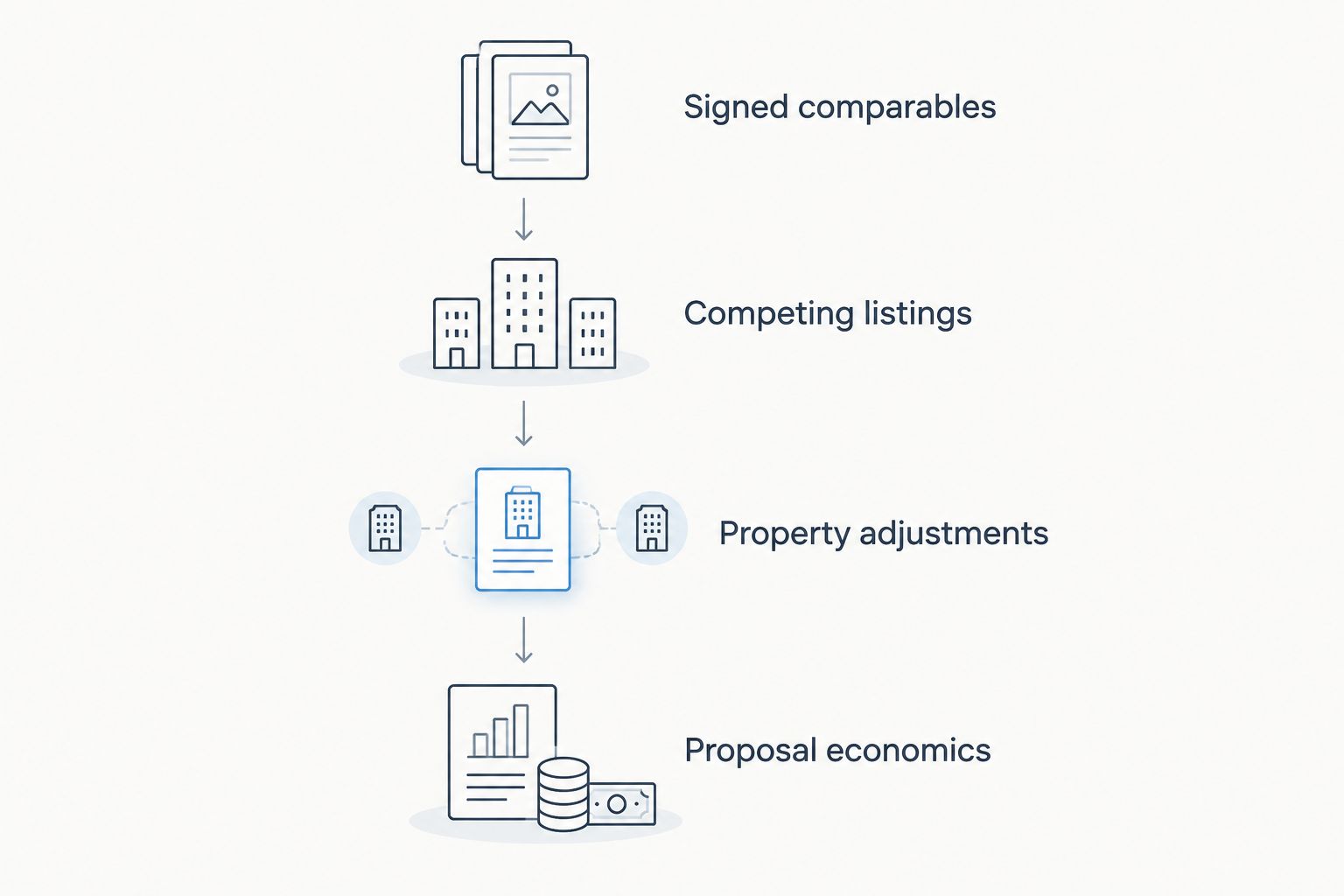
A defensible 2026 rent recommendation needs an evidence hierarchy. Use the following order to organize the discussion, then adjust for the quality and relevance of each comparable.
1. Signed comparables
Start with completed leases that match the subject property and intended use. Confirm the agreement date, lease basis and material concessions where that information is available and appropriate to use.
Strength: Reflects an agreed transaction rather than a seller's or landlord's initial position.
Limitation: A signed lease still needs adjustment for timing, condition and terms.
2. Competing listings
Review spaces that the tenant can lease instead of yours. Record the date of the comparison and distinguish advertised terms from terms confirmed during negotiations.
Strength: Shows the alternatives facing a current prospect.
Limitation: An asking rate is not an achieved rate.
3. Property adjustments
Write down the differences that affect usability: loading, power, office area, yard rights, condition and permitted activity. Explain the differences without assigning an unsupported premium to every feature.
Strength: Connects the comparison to the actual property.
Limitation: An owner's improvement cost does not establish what a tenant will pay.
4. Proposal economics
Compare the full proposals, including increases, concessions, improvement obligations and expense allocation. Keep landlord-paid work visible rather than burying it beneath the base-rent figure.
Strength: Reveals differences between otherwise similar offers.
Limitation: The comparison depends on clearly defined responsibilities.
Normalize the lease terms before choosing an asking rent
Industrial rent comparisons fail when the units or expense obligations differ. A rate quoted per square foot per month must be multiplied by 12 months to express the same base rent per square foot for 1 year. That conversion does not add operating expenses or account for concessions.
Use 1 square foot as the common area unit throughout the worksheet. Confirm that the area used for quoting rent matches the area used to calculate the obligation.
Then separate these items:
- Base rent: The amount charged for occupancy before separately payable expenses.
- Operating expenses: The obligations allocated under the actual lease language.
- Increases: When and how the rent changes.
- Concessions: Negotiated benefits that affect the agreement's economics.
- Improvements: Who approves, performs and pays for required work.
- Delivery condition: What must be ready when the tenant takes possession.
Do not assume every lease described as NNN assigns identical responsibilities. Read the expense provisions, exclusions and repair language before comparing proposals.
How this comparison is organized
The city sections follow the owner's decision process: start with the property's location, identify workable alternatives and test the differences. They do not assign cities an unsupported rent position.
For a 2026 listing, the strongest recommendation connects an asking rent to identifiable alternatives and written lease assumptions. Javier Brown's industrial leasing discussion should center on those property-specific facts, not a city label alone.
Which comparison should you choose?
Start with direct competitors in your property's city, then expand only to locations the target tenant can use. For an Ontario, California, owner, that means establishing the Ontario comparison before treating another Inland Empire city as interchangeable.
Before signing a listing agreement, ask Javier Brown how the proposed positioning addresses competing buildings, permitted use, delivery condition and landlord obligations. Request a clear explanation of what would trigger a pricing or marketing adjustment.
FAQ
Which Inland Empire city has the lowest industrial lease rates?
A cheapest-city label is not enough to identify the lowest-cost workable property. Compare matched buildings, the same lease basis and the tenant's permitted use before choosing a location.
How should I compare Ontario industrial rent with Fontana?
Compare Ontario, California, and Fontana properties that can serve the same tenant requirements. Match building utility, yard rights, lease terms and delivery condition before comparing base rent.
Are industrial asking rents the same as signed lease rates?
No. Asking rent is a proposed term, while a signed lease records an agreement that can include concessions, improvements and other negotiated obligations.
How do I convert monthly industrial rent to an annual rate?
Multiply the monthly rate per square foot by 12 months to express the annual base rate per square foot. Compare operating expenses and concessions separately.
Does NNN rent include every property expense?
The lease determines which expenses the tenant pays and which remain with the landlord. Review the expense definitions, exclusions and repair obligations rather than relying on the NNN label.
Should I improve my industrial property before listing it?
Identify the target tenant and required delivery condition before committing to improvements. Separate necessary repairs from optional work that the next tenant might not need.
Who can help me lease an industrial property in Ontario, California?
Javier Brown provides commercial real estate sales and leasing brokerage in Ontario, California, and the surrounding Inland Empire. Ask for a property-specific discussion of competing spaces, lease structure and landlord obligations.
One last thing
Ask the prospective tenant which other buildings remain on the shortlist. That answer helps distinguish an actual competitor from a listing that merely looks similar on paper.
Then check the differences yourself. Your strongest rent argument explains why the property works for that tenant—not why an entire city deserves a higher rate.