Best overall starting point: Ontario, California. Best for freeway-oriented trucking operations: Fontana. Best for a Riverside-centered business: Riverside. This 2026 guide compares the best Inland Empire cities to buy warehouses by operating needs—not an unsupported promise that one city has the cheapest buildings.
- Ontario, California, leads this shortlist for buyers comparing warehouse ownership around an Ontario-centered operation.
- Fontana deserves consideration when Interstate 10 and Interstate 15 access drives warehouse selection.
- Riverside, San Bernardino, and Moreno Valley serve different operating footprints; compare actual addresses before choosing.
- Javierbrown provides warehouse brokerage for Inland Empire owners and investors buying, selling, or leasing commercial property.
Why this matters
A warehouse purchase ties your business to a particular building, truck entrance, utility service, and set of permitted uses. A city name does not tell you whether those details work. The wrong property remains wrong even in your preferred market.
For owners preparing to sell, the same logic runs in reverse: identify the buyer whose operation fits your building before choosing an asking strategy. Javierbrown provides commercial sales and leasing representation across Ontario, California, and the surrounding Inland Empire.
Javierbrown warehouse brokerage is best for Inland Empire owners and investors seeking representation for a commercial purchase, sale, or lease. The city shortlist below helps frame that conversation; it does not replace property-level investigation.
What makes the best Inland Empire warehouse location?
Use these criteria before comparing cities in 2026. Give each criterion a clear pass or fail rather than letting a good-looking building hide an operating problem.
- Permitted use: Confirm your exact activity with the responsible city department. A warehouse designation does not automatically authorize outdoor storage, truck parking, or every industrial process.
- Truck access: Check legal routes, driveway geometry, loading access, and on-site circulation for the vehicles you actually use.
- Building fit: Verify clear height, loading configuration, power, fire protection, office space, and required improvements.
- Operating footprint: Map customers, suppliers, employees, and recurring deliveries against the actual address.
- Ownership purpose: Separate an owner-user purchase from an investment purchase. Operational usefulness and dependable rental income require different investigations.
- Exit flexibility: Examine whether another permitted user could occupy the building without extensive changes.
No city wins every category. Your shortlist should reflect the factors that would stop a purchase, not a generic popularity ranking.
Best warehouse cities at a glance
The order below is a practical starting sequence, not a ranking of appreciation, transaction volume, or investment returns. No city receives a budget award without comparable property evidence.
| City | Best for | Standout location feature | Key limitation |
|---|---|---|---|
| Ontario, California | Ontario-centered owner-users | Ontario International Airport and the I-10/I-15 area | Citywide appeal does not establish property suitability |
| Fontana | Freeway-oriented trucking operations | I-10 and I-15 corridors | A nearby freeway does not guarantee suitable truck access |
| Riverside | Businesses serving Riverside customers | Riverside location with access to SR-91, SR-60, and I-215 | Cross-town travel requires address-specific checking |
| San Bernardino | Operations organized around the I-10/I-215 area | Connection to both freeway corridors | Loading, access, and permitted use remain parcel-specific |
| Moreno Valley | Businesses serving eastern Riverside County | SR-60 and I-215 corridors | A poor fit when recurring trips concentrate farther west |
1. Ontario: best warehouse city for Ontario-centered owner-users
Ontario is the default starting point when your business already operates in or around Ontario, California. Ontario International Airport and the surrounding freeway network provide concrete reasons to investigate the city, but airport proximity matters only if your business uses it.
For a 2026 purchase, compare buildings against your current operating address. Record what changes for employees, deliveries, customer visits, and loading before treating relocation as an improvement.
Ontario pros:
- Keeps an Ontario-centered search focused on your existing operating area.
- Provides a relevant location for businesses that use Ontario International Airport.
- Lets you investigate addresses around the I-10 and I-15 corridors.
Ontario cons:
- Airport proximity adds little when your freight never moves by air.
- A desirable location cannot correct inadequate loading or an incompatible use.
Best for: Owner-users whose customers, workforce, and recurring trips already center on Ontario.
Verdict: Buy in Ontario only when the specific building passes your operating and financial checks; use the city as the default search area, not an automatic approval.
2. Fontana: best warehouse city for freeway-oriented trucking
Fontana belongs on the shortlist when your operation depends on the I-10 and I-15 corridors. The useful question is not how close a building looks to a freeway, but how your drivers legally reach its loading area.
Trace the route from the interchange to the property entrance. Then inspect turns, gates, trailer movement, and conflicts between truck circulation and employee parking.
Fontana pros:
- Offers a relevant search area for operations using the I-10 corridor.
- Offers a relevant search area for operations using the I-15 corridor.
- Supports a focused comparison based on your actual trucking routes.
Fontana cons:
- Freeway proximity alone does not confirm a legal or practical truck route.
- Warehouse use does not establish permission for outdoor trailer storage.
Best for: Buyers whose warehouse decision starts with recurring truck movements on those corridors.
Verdict: Buy in Fontana when verified truck access supports your operation; skip a building whose approach or yard creates a daily obstacle.
3. Riverside: best warehouse city for Riverside-centered businesses
Riverside makes sense when your business serves Riverside customers, dispatches local crews, or receives frequent visits from nearby suppliers. Keeping those movements practical matters more than choosing a warehouse elsewhere because its listing looks attractive.
Test customer trips and employee access separately from freight routes. A location that works for deliveries does not necessarily work for your service teams.
Riverside pros:
- Keeps a Riverside-focused business near its existing service area.
- Provides a search area connected to SR-91, SR-60, and I-215.
- Lets you compare warehouse suitability alongside customer access.
Riverside cons:
- A Riverside address does not guarantee convenient trips across the city.
- A customer-friendly location can still have unsuitable freight access.
Best for: Owner-users whose customer service, installation, or distribution work centers on Riverside.
Verdict: Buy in Riverside when the address supports both customer coverage and warehouse operations; hold when those needs conflict.
4. San Bernardino: best warehouse city for I-10/I-215 operations
San Bernardino deserves consideration when the I-10/I-215 area aligns with your delivery network. Start with the routes your business already runs rather than assuming every San Bernardino property offers the same access.
For investors, separate the location discussion from the lease review. A useful location does not establish tenant credit, collectible income, or manageable repair obligations.
San Bernardino pros:
- Provides a search area associated with the I-10 corridor.
- Provides a search area associated with the I-215 corridor.
- Creates an alternative to investigate when your operating map points toward San Bernardino.
San Bernardino cons:
- Citywide descriptions conceal differences in individual approaches and loading areas.
- Corridor access does not prove the strength of an occupied building's lease.
Best for: Buyers whose recurring movements make the I-10/I-215 area operationally relevant.
Verdict: Buy in San Bernardino when the property matches your route network and ownership plan; hold until access and lease questions are resolved.
5. Moreno Valley: best warehouse city for eastern Riverside coverage
Moreno Valley belongs on the list when your customers, workforce, or delivery territory pull your business toward eastern Riverside County. Its SR-60 and I-215 connections give you specific corridors to investigate.
Do not expand east simply to widen the search. Establish what your operation gains and what recurring trips become less practical.
Moreno Valley pros:
- Keeps an eastern Riverside County search geographically focused.
- Provides access to investigate along the SR-60 corridor.
- Provides access to investigate along the I-215 corridor.
Moreno Valley cons:
- Adds little operational value when most recurring trips concentrate farther west.
- City selection does not resolve power, loading, or permitted-use requirements.
Best for: Businesses whose service territory or operating base already favors eastern Riverside County.
Verdict: Buy in Moreno Valley when your operating map supports the location; skip the city when the move works against your recurring trips.
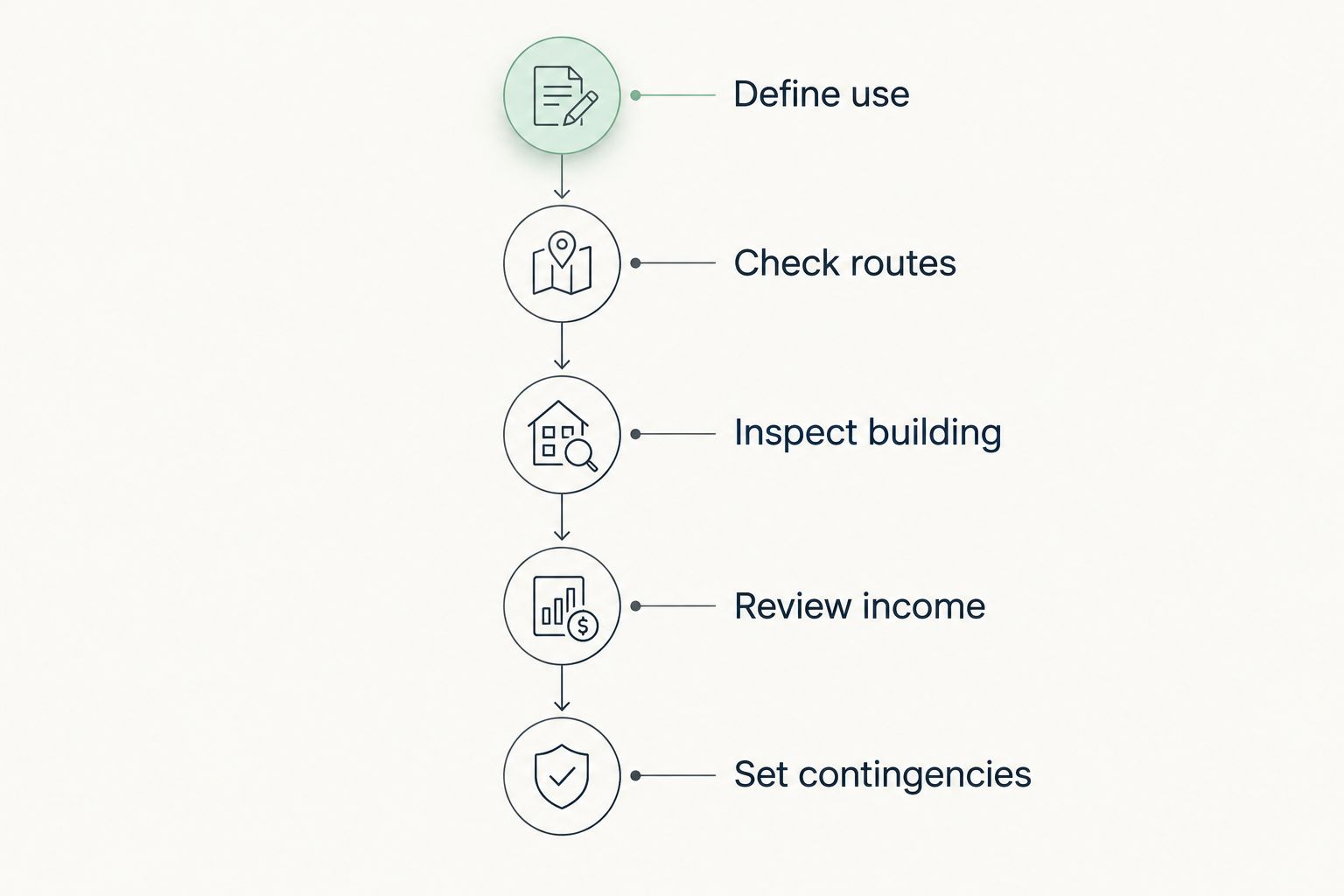
Turn the city shortlist into a purchase decision
For your 2026 search, use the same investigation sequence for every finalist. Consistent questions make competing properties easier to compare and prevent a seller's presentation from setting your priorities.
Define use
Write down what happens inside and outside the building: storage, assembly, customer visits, dispatch, vehicle parking, and any outdoor activity. Give that description to the appropriate city staff; do not ask only whether the parcel is industrial.
Check routes
Run 3 route checks at times relevant to your operation: inbound delivery, outbound dispatch, and employee arrival. Record restrictions and physical obstacles, not just estimated travel time.
Inspect building
Have qualified professionals evaluate the systems and conditions that affect your intended occupancy. Confirm whether your operation needs changes to electrical service, loading, fire protection, accessibility, or building permits.
Review income
For an occupied property, request a current rent roll and 12 months of collection records as an initial review package. Ask for 24 months of operating expense records to compare recurring obligations and investigate changes; these are document-request recommendations, not claims about a particular property.
Set contingencies
Make the purchase agreement's investigation rights, document requirements, and deadlines match the actual questions still open. Your broker, lender, attorney, and inspectors should understand which unresolved issue would stop the purchase.
What sellers and landlords should take from this ranking
A buyer does not purchase your city's reputation. The buyer purchases a building with specific rights, obligations, and operating limits. Your 2026 sale preparation should make those details easy to investigate.
Organize these materials before marketing:
- Use documentation: Available approvals, permits, and records relevant to current occupancy.
- Building information: Plans, service records, and known repair issues.
- Access information: Loading arrangements, shared access agreements, and recorded restrictions.
- Lease documents: Executed leases, amendments, guarantees, deposits, and collection records when applicable.
Keep company transactions separate from an individual agent's transaction history when evaluating representation. Ask Javierbrown warehouse brokerage how the proposed sale or lease strategy addresses your property's actual buyer pool, documentation, and operating limitations.
Discuss your warehouse sale or lease
Review your Inland Empire property's intended users, documentation, and representation needs.
How the cities were ranked
This shortlist prioritizes a clear operating use case for each city: Ontario-centered ownership, freeway-oriented trucking, Riverside customer coverage, I-10/I-215 operations, and eastern Riverside coverage. It does not assign market-wide scores or predict returns.
The ranking uses geography and practical purchase criteria rather than unverified transaction statistics. A property that fails permitted-use or building checks drops out regardless of its city's position.
Which Inland Empire warehouse city should you choose?
Start with Ontario, California, if your business already centers there. Compare Fontana for freeway-oriented trucking, Riverside for Riverside customers, San Bernardino for I-10/I-215 operations, and Moreno Valley for eastern Riverside coverage.
For an investment purchase, do not treat this owner-user shortlist as an income ranking. Compare the lease, tenant obligations, operating expenses, building condition, and financing before choosing the property.
FAQ
What's the best Inland Empire city to buy a warehouse in 2026?
Ontario, California, is the default starting point in this guide for an Ontario-centered owner-user. Fontana, Riverside, San Bernardino, or Moreno Valley fits better when your operating routes and customers point elsewhere.
Is Ontario better than Fontana for buying a warehouse?
Ontario fits an Ontario-centered operation, while Fontana deserves consideration for businesses focused on the I-10 and I-15 corridors. Compare legal truck routes, loading, permitted use, and building condition before choosing.
Which Inland Empire city has the cheapest warehouses?
This guide does not identify a cheapest city. Establish a defensible comparison using current, comparable properties and account for condition, occupancy, location, and required improvements.
Can I park trucks outside a warehouse I buy?
Buying a warehouse does not automatically authorize outdoor truck parking or storage. Confirm the proposed activity with the responsible city department and review property-specific restrictions before committing.
Should I buy a vacant warehouse or one with a tenant?
A vacant warehouse aligns with a need to occupy, while a tenant-occupied purchase requires careful review of possession rights and lease obligations. Neither choice is automatically better; your intended use and the executed lease control the decision.
What should I prepare before selling an Inland Empire warehouse?
Prepare available use approvals, building records, access agreements, and lease documents before marketing. Clear records help buyers investigate the property without relying on unsupported listing claims.
One last thing
Test the building against your hardest operating requirement first. If your business cannot function without a particular loading arrangement, electrical service, or permitted outdoor activity, investigate that requirement before debating cities. One failed requirement can end the comparison.