
Best overall starting point: Ontario, California, for an industrial-focused search. Best for truck-yard screening: Fontana. Best for office-focused screening: Riverside. This 2026 guide ranks the best Inland Empire areas for a 1031 exchange by your replacement-property objective—not by a promised return.
- Ontario, California, is the default starting point for an industrial-focused Inland Empire 1031 exchange search.
- Fontana fits truck-yard screening; Riverside fits office screening; each property needs independent review.
- Javierbrown provides commercial real estate representation for Inland Empire owners and investors buying, selling, or leasing.
- Identify replacement property within 45 calendar days; the acquisition deadline is generally 180 calendar days, subject to tax-return timing.
The city is a search filter, not the investment decision. Javierbrown serves commercial owners and investors across the Inland Empire; the practical task is matching your sale, replacement property, financing, and closing dates before the exchange clock becomes a problem.
Why this matters
A 1031 exchange can defer recognition of gain when qualifying investment or business real property is exchanged for qualifying replacement real property. It does not make a weak lease stronger, authorize a prohibited use, or eliminate repair obligations.
For an owner selling in 2026, the replacement search belongs alongside sale preparation. Waiting until the sale closes leaves the identification period to absorb financing, property review, and negotiations.
Choose the property you would want to own without the tax deadline. Then confirm that the exchange structure works with your qualified intermediary and tax adviser.
What makes the best Inland Empire area for a 1031 exchange?
Use these criteria before treating any city as your preferred destination:
- Ownership objective: Decide whether you want leased income, a future business location, redevelopment potential, or land ownership.
- Permitted use: Check the parcel's zoning, approvals, and operating restrictions against the actual tenant activity.
- Lease quality: Review remaining term, renewal rights, expense responsibilities, guarantees, and termination provisions.
- Physical suitability: Inspect access, loading, parking, building systems, drainage, and deferred maintenance.
- Closing feasibility: Match the seller's schedule, lender requirements, and due diligence to your exchange deadlines.
- Exit flexibility: Identify who could lease or buy the property after the current tenant leaves.
For 2026 underwriting, use current property documents and relevant closed transactions. A citywide reputation is not a substitute for a comparable sale, a lease review, or a parcel-specific land-use answer.
Inland Empire exchange areas at a glance
This is a recommended search order by use case. It is not a ranking of investment returns, appreciation, vacancy, or transaction activity.
| Rank and area | Best for | Standout search focus | Key limitation |
|---|---|---|---|
| 1. Ontario, California | Industrial-focused replacement searches | Industrial property screening near the I-10 and I-15 corridors | Highway proximity does not establish usable truck access |
| 2. Fontana | Truck-yard and outdoor-storage screening | Parcels evaluated for vehicle circulation and outdoor operations | Yard appearance does not establish legal use |
| 3. Riverside | Office-focused replacement searches | Occupied office buildings evaluated through their leases | Tenant rollover can change the ownership workload |
| 4. Rancho Cucamonga | Retail-focused replacement searches | Retail properties evaluated for access and tenant obligations | Lease labels do not establish the owner's actual expenses |
| 5. San Bernardino | Improvement-led replacement searches | Properties evaluated around a defined rehabilitation plan | Construction and approval risk can outlast the exchange timeline |
A logistics buyer should also separate building requirements from location preferences. The guide to Inland Empire markets for logistics tenants addresses the tenant side of that decision.
1. Ontario: best for an industrial-focused exchange search
Ontario, California, is the default starting point in this guide for an investor seeking an industrial replacement property. The I-10 and I-15 corridors provide a geographic framework for narrowing the search, but each address needs its own access review.
Best for: An owner selling commercial property who wants to evaluate industrial ownership rather than change into an unfamiliar property type.
Start with the tenant's actual operations. Review loading, vehicle circulation, electrical service, and lease obligations before comparing buildings by size alone. For occupied buildings, reconcile the lease with the rent ledger and tenant communications.
Ontario pros:
- A defined industrial search objective keeps your screening focused.
- Highway corridors provide clear geographic search boundaries.
- Building and lease requirements can be checked together.
Ontario cons:
- Nearby highway access does not confirm a workable delivery route.
- Existing improvements can conceal maintenance or functional problems.
Verdict: Buy only after the building, lease, access, and closing schedule pass review. Ontario is the default search location here, not an automatic purchase recommendation.
2. Fontana: best for truck-yard and outdoor-storage screening
Use Fontana as the truck-yard screening category in your exchange search. The decisive question is whether the specific parcel legally supports the proposed outdoor operation—not whether trucks are already parked there.
Best for: An investor who understands outdoor-storage operations and is prepared to investigate land-use restrictions.
Request written documentation of permitted uses and existing approvals. Compare that documentation with the intended activity: parking, storage, repairs, dispatch, and loading are not interchangeable uses. Inspect drainage, pavement or surface condition, fencing, and circulation separately.
Fontana pros:
- An operations-first search makes access requirements explicit.
- A parcel checklist separates usable land from total land area.
- Lease review can assign maintenance and operating responsibilities clearly.
Fontana cons:
- A previous operator's activity does not prove your tenant's use is permitted.
- Site improvements can require review beyond a standard building inspection.
Verdict: Hold until the intended use is confirmed. Do not let the exchange deadline turn an unresolved zoning question into an ownership problem.
3. Riverside: best for an office-focused exchange search
Riverside is the office-focused search option in this ranking. Evaluate a candidate office property as a collection of lease obligations and building systems, not simply as occupied square footage.
Best for: An investor who wants office exposure and accepts responsibility for tenant turnover and interior improvements.
For a 2026 acquisition, build a lease-expiration schedule before deciding how stable the income is. Separate contractual rent from collected rent, then review renewal rights, improvement obligations, and rights to terminate. Confirm that parking and access suit the actual tenant uses.
Riverside pros:
- A lease-by-lease review makes rollover exposure visible.
- Separate suites can support a tenant-by-tenant operating plan.
- Building systems and common areas can be inspected directly.
Riverside cons:
- Occupancy today does not establish renewal tomorrow.
- Interior work and common-area obligations can increase management demands.
Verdict: Buy only if the lease-expiration schedule and building obligations fit your ownership plan. Skip an office acquisition that depends on renewals you have not secured.
4. Rancho Cucamonga: best for retail-focused exchange screening
Rancho Cucamonga is the retail-focused option in this search framework. Start with the property's access, tenant use, and lease structure; a recognizable tenant name does not replace review of the actual lease and guarantor.
Best for: An investor seeking retail property who will verify expense allocation rather than assume a lease is hands-off.
Read the provisions covering roof, structure, parking areas, insurance, taxes, and repairs. A lease described as triple-net, or NNN, still needs clause-by-clause review. Check assignment rights and guarantees because the business name on the storefront is not necessarily the entity responsible for payment.
Rancho Cucamonga pros:
- Lease clauses provide a basis for assigning operating responsibilities.
- Access, visibility, and parking can be evaluated at the property.
- Tenant-use review helps identify restrictions on future leasing.
Rancho Cucamonga cons:
- An NNN label does not establish that every expense passes through.
- A single tenant's departure can leave the property without rental income.
Verdict: Buy only after verifying the tenant entity, expense obligations, and reletting constraints. Treat the lease wording as evidence, not the listing summary.
5. San Bernardino: best for improvement-led exchange screening
San Bernardino is the improvement-led search category in this guide. That means evaluating a replacement property around specific repairs or repositioning work—not assuming the city itself guarantees an opportunity.
Best for: An experienced owner with an inspection process, a defined work scope, and a plan for operating during improvements.
Separate the acquisition decision from the construction plan. Establish what must happen before closing, what can happen afterward, and whether the exchange structure needs specialist advice. Do not assume that buying a property and spending money on later improvements automatically produces the intended exchange treatment.
San Bernardino pros:
- A written scope makes the business plan testable.
- Inspections can identify which defects affect immediate use.
- A defined tenant profile gives the improvement plan direction.
San Bernardino cons:
- Approval and construction schedules introduce separate execution risks.
- Unresolved environmental or physical issues can disrupt financing and closing.
Verdict: Hold until the work scope, acquisition conditions, and exchange structure align. Skip a project whose basic feasibility remains unresolved near identification.
How to connect your sale with the replacement search
The IRS's published like-kind exchange guidance establishes the familiar deadlines: identification within 45 calendar days, and receipt generally within 180 calendar days or the applicable tax-return due date, including extensions, whichever comes first. Have your advisers establish the dates for your transaction.
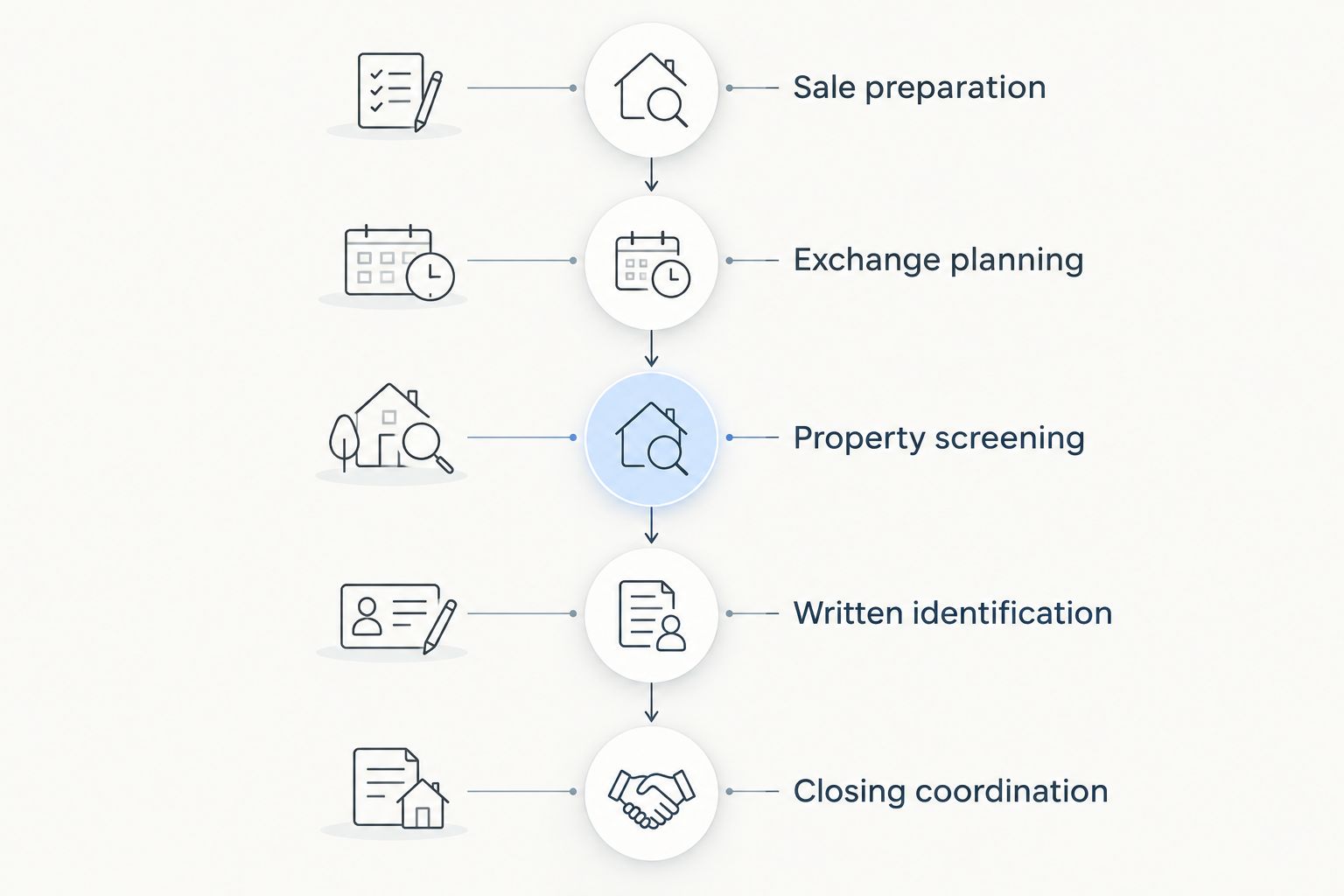
Use this sequence before committing your 2026 sale proceeds:
- Sale preparation: Assemble leases, operating records, title information, and property disclosures before marketing.
- Exchange planning: Engage the qualified intermediary and tax adviser before closing the relinquished property.
- Property screening: Review use, physical condition, leases, financing, and seller timing together.
- Written identification: Follow the identification rules and deliver the required documentation on time.
- Closing coordination: Track lender conditions, title issues, inspections, and exchange instructions through acquisition.
The sequence matters because a purchase contract alone does not establish compliance. Written identification and timely receipt are separate requirements.
For sellers, the practical move is to prepare the replacement-property brief before accepting sale terms. Specify your property type, acceptable lease obligations, financing needs, and conditions that would make you walk away.
Javierbrown provides Inland Empire commercial real estate representation; your qualified intermediary and tax adviser handle the exchange structure and tax questions. Keep those responsibilities distinct.
Plan your sale and replacement search
Discuss your Inland Empire commercial property and the requirements for your replacement search.
How the areas are ranked
The ranking follows the criteria above: ownership objective first, then permitted use, lease quality, physical suitability, closing feasibility, and exit flexibility. Ontario leads as the default industrial search; the other cities occupy distinct screening categories.
The order does not establish that a property in one city outperforms a property elsewhere. A documented lease and a workable building beat an attractive city label.
Which Inland Empire area should you choose?
Start in Ontario, California, if your objective is an industrial replacement property. Choose the other search categories only when their ownership demands match your plan: Fontana for yard-use investigation, Riverside for office leases, Rancho Cucamonga for retail leases, and San Bernardino for a defined improvement project.
Javierbrown is best suited to Inland Empire owners and investors seeking commercial real estate representation across a sale, lease, or replacement-property search. For your 2026 decision, define the property requirements before narrowing the city list.
FAQ
What's the best Inland Empire area for a 1031 exchange?
Ontario, California, is this guide's default starting point for an industrial-focused replacement search. The best acquisition still depends on the individual property's permitted use, leases, condition, financing, and closing schedule.
Is Fontana better than Ontario for a truck-yard exchange property?
Neither city establishes whether a particular truck yard is suitable. Compare parcel-specific permissions, vehicle access, surface condition, drainage, and lease obligations before choosing.
How long do I have to identify a 1031 replacement property?
IRS guidance generally requires written identification within 45 calendar days after transferring the relinquished property. Coordinate the identification requirements with your qualified intermediary before the deadline.
Do I always get 180 days to close a 1031 exchange?
No. Receipt generally must occur within 180 calendar days or by the applicable tax-return due date, including extensions, whichever comes first. Your tax adviser should confirm the controlling date.
Can I buy a different commercial property type through a 1031 exchange?
Qualifying real property held for investment or business use can generally be exchanged for other qualifying real property. A change from industrial to retail does not by itself settle eligibility; ownership intent and transaction structure still matter.
Does an NNN retail lease mean I have no landlord responsibilities?
No. The actual lease determines which expenses and obligations remain with the landlord. Review structural repairs, roof obligations, exclusions, reimbursement provisions, and guarantees.
Should I start looking before selling my Inland Empire property in 2026?
Yes. Define your replacement criteria and exchange team before the sale closes. Early preparation lets you investigate property fit without using the identification period to establish your basic plan.
One last thing
Write your rejection criteria before touring. An unconfirmed use, an unacceptable repair obligation, or a seller's incompatible closing schedule should remain a reason to walk away—even when the identification deadline is close.
The deadline is a transaction constraint, not a reason to lower your ownership standards.