Best overall starting point: Ontario, California. Best for freight-oriented land searches: Fontana. Best for customer-facing commercial projects: Riverside. Best for phased-development screening: Moreno Valley. Best for comparing freeway access: San Bernardino. This 2026 guide ranks search locations by intended use—not by promised returns—and explains what owners must document before selling or leasing commercial land.
- Ontario, California, is the default starting point in this best Inland Empire cities for land guide.
- Fontana deserves consideration for freight-oriented searches, but zoning and legal truck access decide parcel suitability.
- Riverside suits a customer-facing search; Moreno Valley suits phased-development screening; San Bernardino suits freeway-access comparisons.
- Javier Brown provides commercial land brokerage for Inland Empire owners and buyers; parcel evidence comes before city rankings.
Why this matters
A city gets your property onto a shortlist. A documented use gets a buyer closer to a decision. Industrial development, truck parking, retail construction, and long-term land holding require different checks. An empty parcel does not automatically qualify for any of them.
For a seller, the practical question is not simply which city attracts attention. It is which buyers can use the property, what they must verify, and which unresolved issues belong in the negotiation. Javier Brown handles commercial real estate sales and leasing across the Inland Empire, including land.
Use this 2026 ranking to organize your search or listing strategy. Keep the final decision tied to the parcel's jurisdiction, permitted use, access, utilities, and physical constraints.
What makes the best Inland Empire city for commercial land?
These criteria determine the order below. Each city has a different search role; none receives a blanket endorsement for every parcel.
- Use permission: Confirm zoning, applicable plans, overlays, and the approval required for the actual operation.
- Legal access: Establish recorded access rights, driveway feasibility, and routes suitable for the intended vehicles.
- Usable area: Separate gross acreage from land affected by easements, setbacks, drainage, or other restrictions.
- Utility feasibility: Identify the providers, connection requirements, and capacity needed for the project.
- Buyer fit: Match the property to owner-users, developers, investors, or land tenants instead of advertising every possible use.
Best cities at a glance
| Rank and city | Best for | Standout search advantage | Key limitation |
|---|---|---|---|
| 1. Ontario, California | A balanced commercial-land starting point | Access to the I-10 and I-15 corridors and Ontario International Airport | Regional access does not establish parcel-level development feasibility |
| 2. Fontana | Freight-oriented land searches | Location along the I-10 and I-15 corridors | Truck routes and outdoor-storage permissions require separate checks |
| 3. Riverside | Customer-facing commercial projects | A search centered on customers, visibility, and local access | Frontage alone does not establish usable vehicle access |
| 4. Moreno Valley | Phased-development screening | A location to evaluate against a staged project plan | Later phases need their own infrastructure and approval analysis |
| 5. San Bernardino | Comparing freeway-access alternatives | Access to the I-10 and I-215 corridors | A nearby freeway does not prove a workable route to the parcel |
1. Ontario: best for a balanced commercial-land search
Ontario, California, is the default starting point when you want to compare commercial land against both regional transportation and local business needs. The city connects to the I-10 and I-15 corridors and contains Ontario International Airport. Those geographic facts justify a search—not an assumption that a particular parcel supports logistics or industrial development.
For an Ontario owner preparing a 2026 listing, identify the intended buyer before writing the property description. A developer needs a different information package from a business owner seeking space for operations.
Ontario pros:
- You can evaluate freeway and airport relationships within the same search.
- The location supports comparing local access with regional transportation needs.
- A clearly defined use creates a focused parcel shortlist.
Ontario cons:
- Airport proximity requires checking applicable airport land-use restrictions.
- Nearby industrial buildings do not establish the subject parcel's permitted uses.
Best for: Owners and buyers who need a broad starting point before narrowing to a specific commercial use.
Verdict: Buy only after parcel-level approval, access, and utility checks support the intended project.
2. Fontana: best for freight-oriented land searches
Fontana belongs on the shortlist when the intended operation depends on freight movement. The I-10 and I-15 corridors provide the geographic starting point. Your next task is to trace the actual route between the parcel and the freeway.
For a landowner, distinguish a development site from a proposed truck yard. Outdoor vehicle storage, truck parking, repair work, and building construction are different uses; do not combine them into a single unsupported claim.
Fontana pros:
- The freeway corridors give freight users a clear geographic screening framework.
- Route analysis connects the land search to the buyer's actual operation.
- A specific operational description helps separate suitable inquiries from unsuitable ones.
Fontana cons:
- Legal truck routing requires verification beyond a map search.
- Paving, drainage, security, and use approvals require separate review for yard operations.
Best for: Freight-oriented buyers and owners whose land has documented suitability for the proposed operation.
Verdict: Hold until truck access and the exact land use are confirmed.
3. Riverside: best for customer-facing commercial projects
Riverside is the shortlist choice for a customer-facing project when your comparison centers on who visits the site and how they enter it. Start with the intended service area, then examine frontage, driveway access, visibility, and the surrounding uses.
For a seller, translate those features into evidence. Identify existing access rights and relevant planning documents rather than calling a parcel ideal for retail, medical, or service development without checking the proposed use.
Riverside pros:
- A customer-led search keeps the project focused on its intended users.
- Site visits help assess visibility and approach from different directions.
- Access and circulation provide concrete subjects for buyer discussions.
Riverside cons:
- Visible frontage does not guarantee permission for a new driveway.
- Parking, circulation, and setbacks reduce the area available for buildings.
Best for: Buyers evaluating a customer-facing commercial project and sellers with evidence supporting that use.
Verdict: Buy only when the access plan and permitted use fit the customer experience the project requires.
4. Moreno Valley: best for phased-development screening
Moreno Valley earns a distinct place on this list for buyers organizing a staged-development search. The city connects with State Route 60 and I-215. Evaluate that geography alongside the full development plan rather than treating the first construction phase as the whole project.
For a 2026 listing, separate present conditions from future proposals. A conceptual layout is not an approved site plan, and a utility line near the property is not confirmation of sufficient service capacity.
Moreno Valley pros:
- A phased approach forces early discussion of the project's final footprint.
- Separate milestones make approval and infrastructure questions easier to track.
- Buyers can compare the initial use with the intended long-term development.
Moreno Valley cons:
- Later phases remain subject to their own feasibility and approval requirements.
- Early infrastructure decisions can constrain the eventual site layout.
Best for: Buyers with a defined phased-development concept and owners able to distinguish existing conditions from proposed improvements.
Verdict: Hold until the entire project—not just its opening phase—has a credible feasibility path.
5. San Bernardino: best for comparing freeway-access alternatives
San Bernardino belongs in an access-led comparison because of the I-10 and I-215 corridors. Measure the practical route to the parcel, including turns, intersections, and the final approach. Straight-line distance leaves out the part your vehicles actually travel.
For owners, access documentation is more useful than a broad transportation claim. Provide the parcel boundaries and recorded access information, then let the proposed operation determine which route needs review.
San Bernardino pros:
- The freeway corridors provide a clear basis for comparing regional routes.
- Route mapping exposes differences that a city-level search misses.
- Access-focused marketing gives operational buyers a specific issue to evaluate.
San Bernardino cons:
- A freeway location does not establish legal or practical truck access.
- The property's jurisdiction and applicable land-use rules still require confirmation.
Best for: Buyers comparing access alternatives and sellers whose strongest documented feature is the route to the site.
Verdict: Buy only after confirming the complete access route and the proposed use.
How the cities are ranked
This is a use-case ranking, not a forecast of appreciation or a claim about transaction volume. Ontario leads as the broad starting point. Fontana, Riverside, Moreno Valley, and San Bernardino each serve a different screening task.
The same five criteria apply everywhere: use permission, legal access, usable area, utility feasibility, and buyer fit. A suitable parcel in the fifth-ranked city beats an unsuitable parcel in the first.
Before listing land in 2026, build the property file
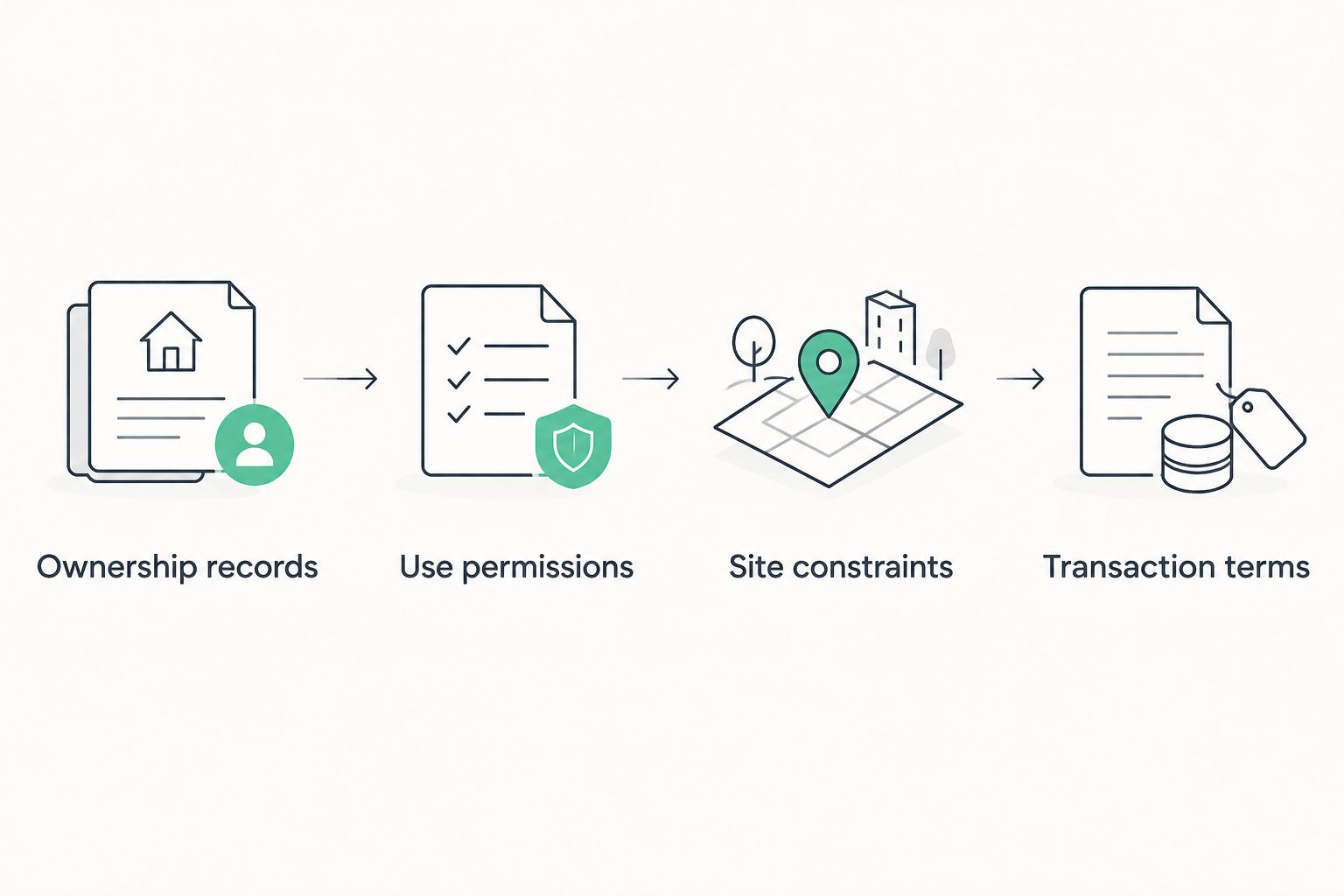
A useful listing package answers basic questions before a buyer has to reconstruct the property from scattered records. Start with these four parts:
- Ownership records: Gather the legal description, parcel identifiers, title information, and recorded easements.
- Use permissions: Identify the governing jurisdiction, zoning designation, applicable plans, and approvals already granted.
- Site constraints: Collect available surveys, utility information, drainage records, and environmental reports. Identify their dates and scope.
- Transaction terms: Decide whether you are offering a sale, a ground lease, or both, and identify the conditions that matter to you.
Keep gross acreage separate from usable area. One acre equals 43,560 square feet; half an acre equals 21,780 square feet; two acres equal 87,120 square feet. These are area conversions, not building footprints. Setbacks, easements, drainage, access, and other requirements determine how much land the project can actually use.
For Javier Brown commercial land brokerage, the useful starting conversation is what you own, what the records establish, and whether you want to sell or retain ownership through a lease.
Sell or ground lease the land?
A city ranking does not answer this ownership decision. A sale transfers the property under the purchase agreement. A ground lease gives a tenant rights to use the land under negotiated terms while the owner retains ownership.
| Option | Best for | Main benefit | Main drawback |
|---|---|---|---|
| Sale | Owners seeking an exit | Ends ownership after closing, subject to surviving obligations | You give up future ownership and control |
| Ground lease | Owners seeking to retain the land | Preserves ownership while establishing a contractual income arrangement | Tenant performance and long-term lease terms require careful evaluation |
For a ground lease, address permitted use, improvements, maintenance, insurance, assignment, default, and the condition of the property at the end of the term. For a sale, focus on the buyer's feasibility conditions, deposit provisions, closing requirements, and ability to complete the transaction. Have the agreement reviewed by qualified legal and tax advisers.
Which Inland Empire city should you choose?
Start with Ontario, California, unless your intended use gives another city a clearer role. Choose Fontana for freight-route screening, Riverside for a customer-led search, Moreno Valley for phased-development analysis, and San Bernardino for an access comparison.
For an owner preparing to sell or lease in 2026, the next move is simpler: identify the most supportable use, assemble the records, and set terms around the property's actual condition. Javier Brown commercial land brokerage serves Inland Empire owners who need representation for that sale-or-lease decision.
Discuss your land sale or lease
Review your Inland Empire property's intended use, supporting records, and sale-versus-lease priorities.
FAQ
What's the best Inland Empire city for buying commercial land?
Ontario, California, is the default starting point in this use-case guide. The final choice depends on the parcel's permitted use, legal access, utilities, and physical constraints—not its city ranking.
Is Fontana better than Ontario for truck yard land?
Neither city automatically makes a parcel suitable for a truck yard. Compare the exact use permissions, legal truck routes, drainage requirements, and operating restrictions before choosing.
Can I use vacant commercial land for truck parking?
Vacant land is not automatically approved for truck parking. Confirm the specific use with the governing jurisdiction and review site-improvement and operating requirements before advertising or occupying the property.
Should I sell my Inland Empire land or offer a ground lease?
Sell if your priority is transferring ownership; evaluate a ground lease if retaining the land is central to your plan. Compare the contractual obligations, tenant risk, tax treatment, and end-of-term property requirements with qualified advisers.
What should I prepare before listing commercial land?
Prepare ownership records, land-use information, available site reports, and your preferred transaction terms. Distinguish existing approvals from proposals so buyers can evaluate the property without confusing a concept with permission.
Does a two-acre parcel provide two acres of buildable space?
No. Two acres equal 87,120 square feet of gross land area, but easements, setbacks, drainage, access, and other requirements determine the usable area and potential building footprint.
One last thing
An address that sounds like a city is not proof that city controls the land-use decision. Confirm the parcel's governing jurisdiction before relying on a zoning map or requesting an approval. That check belongs at the beginning of your property review, not after a buyer has written an offer.