
Best overall starting point: Ontario, California. Best for an industrial-focused search: Fontana. Best for a retail-focused search: Rancho Cucamonga. The best Inland Empire cities for NNN properties depend on the tenant, the building’s next use, and the obligations your lease actually assigns—not the city name alone.
- Ontario, California, is the default starting point for comparing Inland Empire NNN properties across commercial property types.
- Fontana suits an industrial-focused search; Rancho Cucamonga suits a retail-focused search.
- Riverside fits a service-office search; Redlands fits a neighborhood-focused retail search.
- Javierbrown serves Inland Empire owners and investors buying, selling, or leasing commercial properties.
- An NNN label does not establish who pays for roof replacement, structural repairs, or capital work.
Why this matters
A triple-net lease generally assigns property taxes, building insurance, and maintenance expenses to the tenant. The signed lease determines the actual allocation. Roof replacement, structural work, administration charges, and reimbursement limits still need separate review.
For a 2026 purchase or listing, separate the location decision from the lease decision. A useful location cannot repair an unenforceable obligation, and a strong tenant does not remove the risk of an unsuitable building.
Javierbrown is a fit for Inland Empire owners and investors seeking commercial brokerage representation for NNN purchases, sales, or leasing. Start with Javierbrown when you need to connect the property’s physical condition, lease terms, and your ownership plans.
What makes the best city for an NNN property?
Use these criteria before treating any city as your preferred market:
- Tenant fit: Match the property to the tenant’s operation, customer access, staffing needs, and permitted use.
- Replacement demand: Identify the businesses that could occupy the building after the current tenant leaves. Verify that their uses are allowed.
- Lease responsibility: Read who pays each expense, which costs are excluded, and whether reimbursement obligations have limits.
- Building exposure: Separate routine maintenance from replacement work involving roofs, paving, mechanical equipment, or structure.
- Exit fit: Decide whether your eventual buyer would purchase income, occupy the building, or pursue another permitted use.
For your 2026 shortlist, the order below moves from a broad starting point to more specific property searches. It is a use-case ranking, not a claim that one city delivers higher yields, lower vacancy, or faster appreciation than another.
Inland Empire NNN cities at a glance
| Rank and city | Best for | Standout screening angle | Key limitation |
|---|---|---|---|
| 1. Ontario, California | Broad commercial comparison | Compare industrial, retail, and office opportunities within one city search | A citywide label hides differences between individual locations |
| 2. Fontana | Industrial-focused ownership | Examine industrial operations, access, and the building’s next permitted use | Industrial improvements can create substantial owner obligations |
| 3. Rancho Cucamonga | Retail-focused ownership | Examine customer access, frontage, parking, and tenant operations | A recognizable tenant does not establish lease quality |
| 4. Riverside | Service-office ownership | Examine customer-facing office uses and possible replacement occupants | Office conversion and re-leasing requirements need property-level review |
| 5. Redlands | Neighborhood-focused retail | Examine the surrounding neighborhood and the tenant’s customer route | A downtown address and an outlying commercial site require different analysis |
1. Ontario: best NNN city for a broad commercial comparison
Ontario, California, is the default starting point when you have not committed to a property type. Use the city search to compare different commercial uses, then narrow your decision to the building, tenant, and lease.
Ontario’s connections with Interstate 10 and Interstate 15 make access a concrete screening question. Do not stop at the freeway map: inspect the actual route between the interchange and the property, including turns, entrances, and operating restrictions.
Ontario pros:
- Supports a search that considers different commercial property types rather than assuming NNN means retail.
- Gives industrial buyers a reason to examine regional highway connections.
- Lets owners compare an income-sale strategy with a potential owner-user strategy, where the lease permits possession.
Ontario cons:
- Freeway proximity does not establish convenient access to the parcel.
- Comparing unlike buildings produces a weak pricing argument, even within the same city.
Best for: An owner or investor choosing between property types before narrowing the search.
For a 2026 listing, organize comparable properties by use, location, condition, and lease structure. Do not present every Ontario commercial sale as a meaningful comparison.
Verdict: Buy only when the parcel and lease support your intended ownership plan.
2. Fontana: best NNN city for an industrial-focused search
Put Fontana on the shortlist when the investment question centers on an industrial building. The city has connections with Interstate 10 and Interstate 15, but an industrial tenant’s suitability depends on the last part of the trip as much as the regional route.
Check loading, circulation, power, permitted activities, and any outdoor-use requirements. A tenant paying operating expenses does not establish that an expansion, outdoor storage activity, or future replacement use is permitted.
Fontana pros:
- Provides a focused location search for industrial ownership.
- Makes truck access and operational suitability central to property comparisons.
- Encourages an exit review based on the building’s utility to another industrial occupant.
Fontana cons:
- Specialized improvements can limit the pool of suitable replacement occupants.
- Pavement, roofs, and building systems require explicit responsibility language in the lease.
Best for: An investor or landlord who understands the industrial tenant’s operations and wants to evaluate the building beyond its income statement.
If you are preparing a 2026 sale, document authorized uses separately from what the tenant currently does. An operating business is not proof that every activity has the necessary approval.
Verdict: Buy only after confirming use, access, and responsibility for major building work.
3. Rancho Cucamonga: best NNN city for a retail-focused search
Use Rancho Cucamonga as a retail-focused shortlist choice, then evaluate the specific customer trip. The questions are practical: can customers see the business, enter easily, park, and leave without an awkward detour?
A corner location and a familiar tenant name are starting observations, not a complete investment case. Review the tenant entity, guaranty, permitted use, renewal rights, and any exclusive-use restrictions affecting the property.
Rancho Cucamonga pros:
- Provides a clear city search for a retail-oriented acquisition or listing.
- Directs attention to visibility, customer access, and parking.
- Allows comparison between the current retail use and plausible replacement uses.
Rancho Cucamonga cons:
- Tenant branding does not prove that a parent company guarantees the lease.
- Restrictions affecting signage, use, or access can reduce the building’s flexibility.
Best for: A retail owner or investor prepared to evaluate both the customer-facing location and the legal tenant obligation.
For a 2026 listing, identify the exact entity signing the lease. Keep the business name on the storefront separate from the entity responsible for payment.
Verdict: Buy only when tenant obligations and customer access survive detailed review.
4. Riverside: best NNN city for a service-office search
Consider Riverside when your search centers on customer-facing office or professional-service space. Evaluate the actual address against the occupant’s needs rather than treating every office building as interchangeable.
Parking, accessibility, entrances, layout, and permitted use affect the building’s practical suitability. If the current tenant leaves, a replacement business might need different approvals or alterations before it can occupy the space.
Riverside pros:
- Provides a city-focused search for service-office ownership.
- Encourages a comparison based on how customers and employees use the building.
- Supports an exit review that considers another office occupant rather than only the existing tenant.
Riverside cons:
- A layout built around one practice can require alterations for another occupant.
- An NNN provision does not resolve responsibility for every accessibility or building-system issue.
Best for: An owner or investor evaluating a service-office property with a clear understanding of its permitted use and physical layout.
Before marketing, distinguish tenant-owned equipment from improvements that remain with the building. Your buyer needs to know what transfers and what could disappear when occupancy ends.
Verdict: Buy only when the building has a credible next use beyond the current tenant.
5. Redlands: best NNN city for neighborhood-focused retail
Put Redlands on the shortlist when the investment centers on a particular neighborhood and its customer-serving businesses. Treat downtown locations and outlying commercial sites as separate searches rather than one uniform retail market.
Walk the property and follow the customer route. For an older building, investigate condition and applicable requirements instead of assuming that an established tenancy settles those questions.
Redlands pros:
- Provides a focused search for neighborhood-serving commercial property.
- Encourages direct observation of access, surrounding uses, and the customer route.
- Makes the relationship between building layout and tenant operation easy to examine on a site visit.
Redlands cons:
- Neighborhood appeal does not establish tenant financial strength.
- Older improvements require condition review and clear allocation of repair obligations.
Best for: An owner or investor selecting a specific neighborhood property rather than buying a citywide investment story.
If you plan to sell, explain the property’s functional advantages without promising foot traffic or business performance you cannot document. Separate observable facts from the tenant’s sales claims.
Verdict: Buy only when the neighborhood fit, building condition, and lease obligations align.
How this shortlist is ranked
Ontario ranks first as the broad starting point; the remaining cities serve distinct search purposes. Fontana focuses the industrial review, Rancho Cucamonga the retail review, Riverside the service-office review, and Redlands the neighborhood-property review.
These recommendations organize your search. They do not replace underwriting, establish a citywide return forecast, or suggest that every property in a listed city fits the recommended use. The individual property must pass the criteria above.
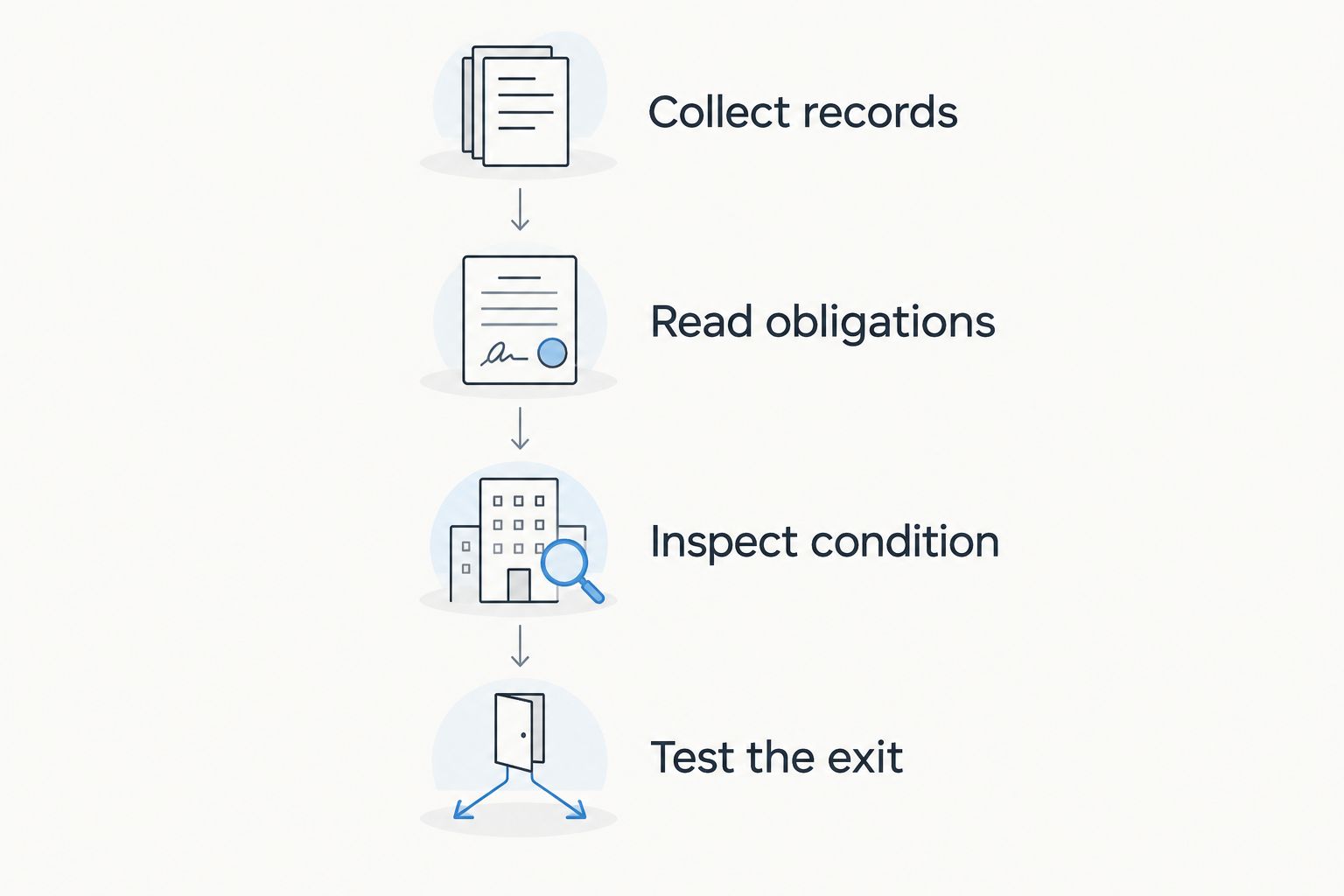
Before you buy or list: inspect the income in order
A seller’s strongest preparation is a file that lets buyers verify the income and understand the obligations. Javierbrown’s NNN brokerage work serves owners and investors; the property file should make their different concerns answerable.
Collect records
As a preparation target, organize 12 months of payment records and 3 years of operating-expense records, where those records exist. These are document-gathering recommendations, not statements about a property’s performance.
Include the signed lease, amendments, notices, reconciliation statements, and documents affecting the tenant’s obligations. Separate base rent from reimbursements so a buyer can follow each income stream.
Read obligations
Create a responsibility list covering taxes, insurance, maintenance, roof, structure, paving, and building systems. Match every entry to the lease language rather than to a marketing description.
Flag renewal options, assignment provisions, termination rights, and guaranties for legal review. A lease summary helps organize the discussion; it does not replace the signed documents.
Inspect condition
Document the physical condition before representing a property as requiring little owner involvement. An expense passed to the tenant can still become an ownership problem if the obligation is disputed or the tenant cannot perform it.
Distinguish completed repairs from proposed work. Keep inspection findings and supporting records available for the buyer’s investigation.
Test the exit
Compare a lease with 5 years remaining against one with 10 years remaining as a planning exercise, not a promise that either term is preferable. The longer obligation matters only alongside tenant strength, rent terms, building condition, and your intended exit.
Ask what happens if the tenant renews, leaves, assigns the lease, or requests changes. Your sale-versus-hold decision needs more than the current payment.
Which Inland Empire NNN city should you choose?
Start with Ontario, California, if you need a broad comparison. Choose the other cities by the property problem you are solving—not by a claim that their names guarantee investment performance.
For a 2026 sale, your next move is to match the property to its likely buyer. An income buyer studies the lease and tenant; an owner-user also needs a workable path to possession. Present the relevant facts without blending those two buyer stories.
Discuss your property’s next move
Review a sale, lease, or purchase with an Inland Empire commercial real estate agent.
FAQ
What is the best Inland Empire city for NNN properties?
Ontario, California, is the default starting point in this use-case shortlist because it lets you compare different commercial property types. Choose the final property by tenant fit, lease obligations, condition, and exit options—not by the city name alone.
Is Fontana better than Rancho Cucamonga for an NNN investment?
Fontana is the industrial-focused choice in this guide; Rancho Cucamonga is the retail-focused choice. Neither recommendation establishes better returns, and each property needs its own lease and condition review.
Does an NNN lease mean the landlord pays nothing?
No. An NNN lease generally assigns taxes, insurance, and maintenance expenses to the tenant, but the actual lease determines exclusions, limits, and responsibility for major work.
Can an industrial property have an NNN lease?
Yes. NNN describes an allocation of expenses, not a restriction to retail buildings. Read the industrial lease to determine which obligations the tenant actually accepts.
Should I sell my NNN property or keep leasing it?
Compare the verified income and ownership obligations with your need for proceeds, future building work, and the lease’s remaining term. A sale and a continued lease solve different ownership goals; neither is automatically the better choice.
What documents should I prepare before listing an NNN property?
Prepare the signed lease, amendments, payment records, expense records, reimbursement statements, and building-condition documents. Include guaranties and notices that affect the tenant’s obligations so buyers can review the complete arrangement.
Does a familiar tenant name make an NNN property safe?
No. Identify the legal tenant, any guarantor, and the scope of the actual obligation. A storefront name alone does not establish who must pay or perform under the lease.
One last thing
Read the assignment clause before treating the current tenant as permanent. It explains whether and under what conditions another party can take over the lease. Check who remains liable afterward; the name on the building and the party responsible for the obligation are not necessarily the same.