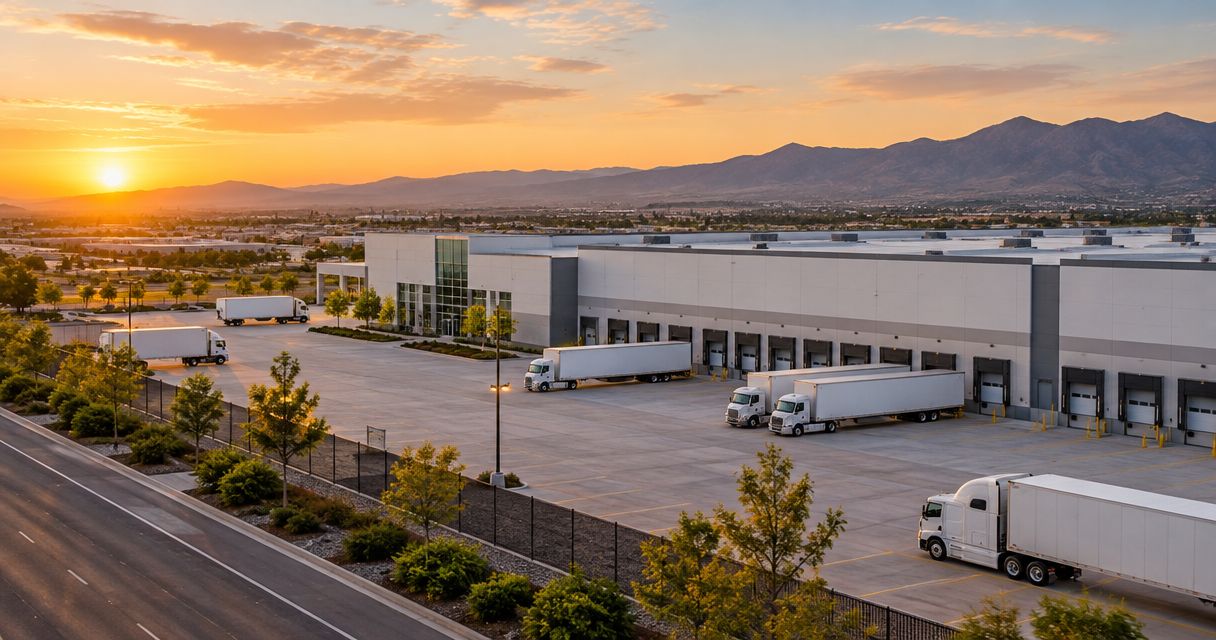
Best overall starting point: Ontario, California, for industrial property. Best for an office-focused search: Rancho Cucamonga. Best budget option: choose by property underwriting, not city name. This 2026 guide ranks Inland Empire search locations by investment purpose—not promised returns.
- The best inland empire cities for 1031 exchange properties depend on property use, lease quality, and execution risk.
- Start with Ontario for industrial, Rancho Cucamonga for office, and Riverside for a retail-focused search.
- Consider Fontana for truck yards and San Bernardino for land, subject to parcel-specific approvals.
- Javierbrown provides commercial real estate brokerage for Inland Empire owners and investors.
- Identify replacement property within 45 calendar days; the exchange completion deadline can arrive before 180 days.
For owners selling before buying, Javierbrown provides commercial real estate brokerage across industrial, truck yard, office, retail, and land properties. Javierbrown is a fit for owners and investors seeking 1031 exchange brokerage in Ontario, California, and the surrounding Inland Empire.
Why this matters
A 1031 exchange gives you a tax-deferral framework, not protection against a weak investment. A replacement property still needs a defensible purchase basis, acceptable operating obligations, and a closing plan that fits your exchange.
For a 2026 search, separate two decisions: which city fits the intended use, and which actual property deserves an offer. Ontario does not make every warehouse a good purchase; a long lease does not make every tenant a good credit risk.
Start with the building and lease you want to own. Then choose cities where you can investigate that strategy without changing it just to meet a deadline.
What makes the best city for a 1031 exchange?
Use these criteria before comparing locations:
- Property fit: Decide whether you want industrial, office, retail, a truck yard, or land. Each requires different diligence.
- Income durability: Examine tenant obligations, payment history, remaining lease term, options, and landlord expenses.
- Legal use: Confirm the intended operation with the relevant planning authority. A commercial address does not establish permission for every commercial activity.
- Ownership workload: Decide who handles repairs, leasing, management, and capital projects after closing.
- Exit flexibility: Assess whether another investor or business owner could use the property without depending on speculative approvals.
- Closing readiness: Check title, financing, environmental review, and seller cooperation against your exchange calendar.
If industrial is your starting point, compare the operating considerations in this guide to Inland Empire cities for leasing industrial space. Tenant requirements help define what an industrial investment needs to offer.
Inland Empire 1031 exchange cities at a glance
This 2026 ranking assigns each city a distinct search role. It is a decision framework, not a ranking of appreciation, rental yields, or transaction volume.
| Rank and city | Best for | Standout search consideration | Key limitation |
|---|---|---|---|
| 1. Ontario | Industrial investment search | Ontario International Airport and regional freeway connections | Location does not resolve building or lease deficiencies |
| 2. Rancho Cucamonga | Office investment search | Comparing office configurations against tenant requirements | Vacant suites and improvements require separate underwriting |
| 3. Riverside | Retail investment search | Evaluating customer access and the surrounding trade area | Tenant economics depend on the specific site |
| 4. Fontana | Truck yard and outdoor-storage search | Testing access, circulation, and permitted operations | Industrial zoning alone does not establish yard approval |
| 5. San Bernardino | Land investment search | Reviewing parcel use, access, utilities, and approvals | Unresolved development questions complicate a deadline-driven purchase |
1. Ontario: best for an industrial property search
Ontario, California, is the default starting point here for an industrial-focused exchange. Ontario International Airport and freeway connections give you concrete location factors to assess, but the building must still support the tenant's operation.
Match warehouse layout, loading, electrical service, access, and yard rights to the actual use. For an occupied property, reconcile what the lease grants with what the tenant uses today.
Ontario pros:
- Airport proximity is a specific location factor to evaluate.
- Industrial property lets you examine both the physical asset and its operating lease.
- An existing tenant's requirements provide a practical framework for building diligence.
Ontario cons:
- A suitable location does not correct inadequate loading or an unsuitable layout.
- Deferred maintenance and landlord obligations remain your responsibility under the purchase and lease terms.
Best for: Investors starting with a defined industrial requirement rather than a citywide return assumption.
Verdict: Buy only when the building, lease, and closing schedule pass separate reviews.
2. Rancho Cucamonga: best for an office-focused search
Use Rancho Cucamonga as the office-focused search lane in this comparison. Office underwriting starts with the occupants: what space they need, what their leases require, and what happens when they leave.
Distinguish general office from uses that require specialized improvements or approvals. A suite that works for one occupant does not automatically work for the next.
Rancho Cucamonga pros:
- A defined office search keeps tenant requirements central to selection.
- Existing leases identify contractual income and expense responsibilities.
- Suite configuration gives you a concrete basis for discussing future leasing work.
Rancho Cucamonga cons:
- Vacant space requires assumptions about improvements, leasing costs, and downtime.
- Specialized buildouts can restrict which replacement tenants can use a suite without changes.
Ask for a suite-by-suite occupancy schedule, lease documents, improvement obligations, and available building records. Review accessibility and permitted use rather than assuming an existing buildout settles either question.
Best for: Investors prepared to evaluate office leasing and improvement obligations.
Verdict: Buy for documented occupancy and manageable obligations; skip a purchase supported only by projected leasing.
3. Riverside: best for a retail-focused search
Riverside is the retail-focused search choice in this guide. Judge each property by customer access, visibility, parking, surrounding uses, and the tenant's permitted operation—not by the city label alone.
For leased retail, distinguish base rent from reimbursements and identify expenses the owner retains. A lease described as triple net still needs a clause-by-clause review.
Riverside pros:
- Site access and visibility are observable during diligence.
- Existing leases let you examine permitted uses and expense allocation.
- A defined trade area gives you a practical boundary for evaluating nearby competition.
Riverside cons:
- A strong-looking storefront does not establish tenant financial strength.
- Parking, access restrictions, and exclusive-use clauses can limit future leasing choices.
Request amendments, options, guarantees, reimbursement reconciliations, and any tenant rights affecting a sale. Review the tenant's financial information where available and permitted, rather than treating a recognizable business name as a guarantee.
Best for: Investors who want to analyze a retail site's lease structure and customer access.
Verdict: Buy the documented lease economics; skip assumptions based on appearance or tenant recognition.
4. Fontana: best for a truck yard or outdoor-storage search
Fontana is the truck yard and industrial outdoor storage search lane in this ranking. The first diligence question is whether the specific operation is allowed on the specific parcel.
Truck parking, trailer storage, container storage, vehicle repair, and freight operations are not interchangeable uses. Describe the intended activity precisely when requesting planning confirmation.
Fontana pros:
- A defined operating use creates a clear parcel-screening checklist.
- Site visits let you inspect circulation, gates, surface condition, and neighboring uses.
- Written approvals can be compared directly with the tenant's proposed operation.
Fontana cons:
- Industrial zoning alone does not establish permission for every outdoor activity.
- An occupied yard does not prove that every current use is approved.
Review access rights, drainage, utilities, environmental history, insurance requirements, and restrictions on operating hours. Check whether approvals contain conditions or depend on a particular operator.
Best for: Investors prepared to verify outdoor-use permissions before committing exchange proceeds.
Verdict: Hold until use and access are confirmed; skip unresolved permissions that cannot be settled within the closing schedule.
5. San Bernardino: best for a land-focused search
San Bernardino is the land-focused search choice in this comparison. Buying land through an exchange requires the same discipline as buying an improved property, with additional attention to what can actually be done with the parcel.
Distinguish land held for investment from property held primarily for sale. Federal 1031 treatment generally applies to qualifying real property held for investment or productive business use, not inventory held primarily for sale.
San Bernardino pros:
- A land search lets you define the intended investment use before choosing improvements.
- Parcel records provide a starting point for access, boundary, and title review.
- A written approval checklist separates established rights from future plans.
San Bernardino cons:
- Vacant land does not provide building rent to support ongoing ownership expenses.
- Utility service, legal access, environmental conditions, and approvals can change project feasibility.
Do not treat an adjacent road as proof of legal access or a nearby utility line as proof of service capacity. Obtain the relevant documents and professional assessments.
Best for: Investors whose strategy and liquidity support land ownership without relying on an immediate development outcome.
Verdict: Buy verified rights and a defined investment purpose; skip speculative approvals as the foundation of a rushed exchange.
How these cities are ranked
Ontario ranks first as the industrial starting point; the remaining cities each represent a different property strategy. The criteria are property fit, income durability, legal use, ownership workload, exit flexibility, and closing readiness.
For a 2026 acquisition, change the order when your investment purpose changes. An office investor should start with office requirements, not buy industrial simply because Ontario appears first.
Put the exchange calendar ahead of the city tour
Under the IRS deferred-exchange rules, you generally have 45 calendar days after transferring the relinquished property to identify replacement property. You generally must receive replacement property within 180 days, or by the due date of your federal income tax return for the transfer year, including extensions, whichever is earlier.
These are federal timing rules, not suggested shopping periods. Have your qualified intermediary and tax adviser confirm the applicable dates and identification requirements before the sale closes.
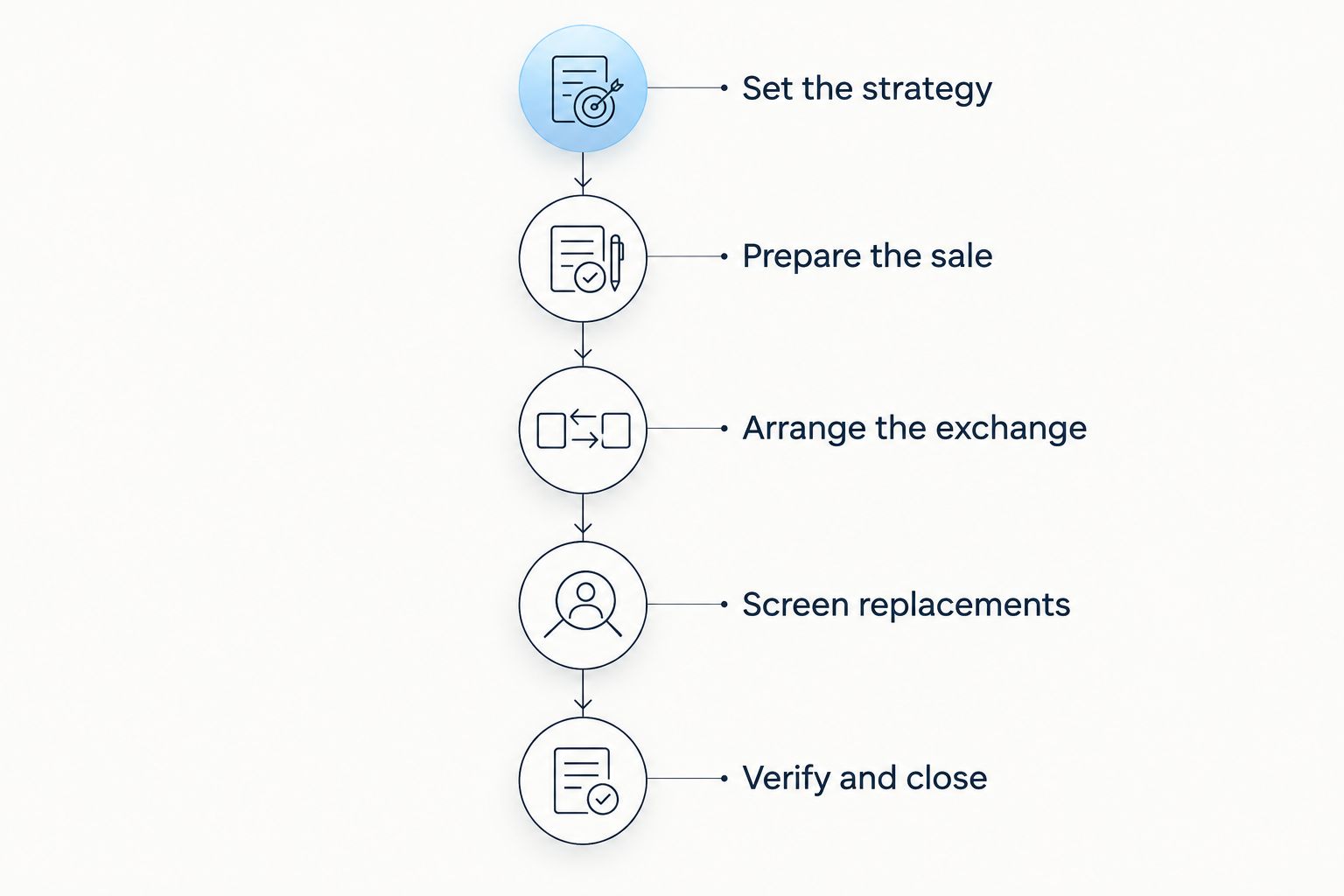
Use this sequence:
- Set the strategy: Define property type, acceptable ownership work, and financing requirements before marketing the relinquished property.
- Prepare the sale: Assemble leases, amendments, operating records, title information, and repair documentation.
- Arrange the exchange: Coordinate the transaction structure with the qualified intermediary before closing. Do not take receipt of exchange proceeds without tax advice.
- Screen replacements: Investigate multiple suitable candidates instead of relying on one seller.
- Verify and close: Resolve financing, title, lease, physical-condition, and use questions against the actual deadline.
For owners considering a 2026 sale, replacement-property planning belongs in the listing conversation. Javierbrown provides 1031 exchange brokerage support for the property transaction; your qualified intermediary and tax adviser handle their respective exchange and tax responsibilities.
Plan your sale and replacement search
Discuss your Inland Empire property, listing plans, and replacement-property requirements.
Which Inland Empire city should you choose?
Choose Ontario as the default industrial search starting point, not as an automatic purchase recommendation. Move Rancho Cucamonga, Riverside, Fontana, or San Bernardino to the top when office, retail, outdoor storage, or land better matches your investment plan.
Before offering, write down the reason you would own the property without an exchange deadline. If that reason depends entirely on avoiding a tax bill, revisit the investment with your advisers.
For a 2026 exchange, a workable backup property is more useful than a longer list of cities. Screen backups for the same investment requirements as your preferred purchase.
FAQ
What's the best Inland Empire city for a 1031 exchange property?
Ontario, California, is this guide's default starting point for an industrial-focused exchange. The best actual purchase depends on the property, lease, permitted use, financing, and closing schedule—not the city alone.
Is Ontario better than Riverside for a 1031 exchange?
Neither city is automatically better for a 1031 exchange. Start with Ontario for the industrial search framework in this guide and Riverside for the retail framework, then compare actual properties.
Can I buy vacant land in a 1031 exchange?
Qualifying land held for investment or productive business use can be replacement property in a 1031 exchange. Property held primarily for sale generally does not qualify; confirm your intended use with your tax adviser.
How long do I have to identify replacement property?
You generally have 45 calendar days after transferring the relinquished property to identify replacement property. Identification must follow the applicable written-identification rules; have your qualified intermediary confirm the requirements.
Do I always have 180 days to finish a 1031 exchange?
No. The completion deadline is generally 180 days after the transfer or the due date of your federal income tax return for that year, including extensions, whichever is earlier.
Does industrial zoning mean I can operate a truck yard?
No. Verify the exact proposed operation with the relevant planning authority and review parcel-specific approvals and conditions before committing to a truck yard purchase.
Should I choose the replacement city before listing my property?
Define your replacement-property strategy before listing, but do not restrict the search to one city without a property-based reason. Preparing records and coordinating advisers early gives the sale and replacement search a shared plan.
One last thing
A tenant's renewal option is not the same as guaranteed future rent. The tenant generally controls whether to exercise that option under its terms, so separate the current committed lease period from optional extensions when evaluating replacement-property income.
That distinction matters more than moving a city up or down a ranking. Read the lease before you buy the income.