
Best starting point: Ontario, California, for an Ontario-centered contractor business. Best alternatives: Fontana for a Fontana-centered service area and Riverside for Riverside-centered work. This 2026 guide ranks Inland Empire contractor yard areas by operating fit, then explains what an owner must verify before offering a property for lease.
- Ontario leads this Inland Empire contractor yard shortlist for businesses whose crews and customers concentrate around Ontario, California.
- Fontana, Rialto, Riverside, and San Bernardino deserve consideration when they match your actual service territory.
- Javierbrown represents Inland Empire commercial property owners; contractor yard marketing should start with documented property facts.
- A city ranking never establishes permission for outdoor storage, equipment parking, repairs, or material handling.
Why this matters
A contractor yard is an operating location, not simply fenced land. Equipment storage, employee parking, loading, deliveries, and dispatch each place different demands on a property. A parcel that accommodates parked vehicles does not automatically accommodate material storage or repair work.
For owners preparing to lease in 2026, the practical question is whether a specific contractor can operate legally and physically on the property. Javierbrown provides commercial real estate brokerage for Inland Empire owners and businesses, including industrial, truck yard, and land properties.
Match the tenant's operation to the parcel before selling the tenant on the city. That rule applies throughout this shortlist. These are starting points for a location search, not claims about current rents, available inventory, or citywide approval of contractor yards.
What makes the best Inland Empire contractor yard areas?
Use these criteria before comparing cities or writing a listing description:
- Service territory: Locate the yard around the jobs, suppliers, and customers the contractor actually serves.
- Permitted use: Verify the proposed activity with the authority responsible for the parcel, including any required approvals and operating conditions.
- Vehicle access: Check the actual approach, driveway, gate, and turning space for the intended vehicles and trailers.
- Usable layout: Separate working yard space from setbacks, easements, drainage areas, and other restrictions.
- Neighbor compatibility: Review operating hours, lighting, dust, noise, and the relationship to nearby properties.
- Lease allocation: Identify who handles approvals, maintenance, improvements, insurance, and restoration when the tenancy ends.
For your 2026 shortlist, ask each prospect for 1 written operating description before promising a fit. It should identify the business activity, equipment, materials, vehicle movements, and proposed hours. A business name alone does not explain how the yard will function.
Inland Empire contractor yard areas at a glance
The order below gives Ontario-centered owners a practical starting point. Move another city to the top when the contractor's service territory supports it; no city receives a blanket zoning endorsement.
| Area | Best for | Geographic reason to consider it | Key limitation |
|---|---|---|---|
| Ontario, California | Ontario-centered contractor operations | Location within the western Inland Empire | A convenient city does not establish parcel suitability |
| Fontana | Fontana-centered crews and suppliers | Location east of Ontario | City proximity does not prove a workable vehicle approach |
| Rialto | Work concentrated between Fontana and San Bernardino | Position between those cities | Boundary and parcel-specific rules still require verification |
| Riverside | Riverside-centered service territories | Location within the Riverside side of the Inland Empire | Cross-region convenience must be checked against actual jobs |
| San Bernardino | San Bernardino-centered operations | Location east of Rialto | A larger search area does not establish usable yard space |
1. Ontario: best contractor yard area for Ontario-centered work
Ontario belongs first when the contractor's customers, projects, or suppliers cluster around Ontario, California. It is the default starting point for this guide's Ontario-focused audience, not a claim that Ontario has the lowest costs or the most suitable parcels.
For an owner, the strongest pitch connects the property to a prospect's actual work. Show how crews enter, equipment is stored, and deliveries reach the yard instead of relying on a general claim about location.
Ontario pros:
- Keeps the search aligned with an Ontario-centered service territory.
- Gives an Ontario property owner a clear target audience for marketing.
- Supports a focused comparison between nearby candidate properties.
Ontario cons:
- An Ontario address does not confirm outdoor storage permission.
- Contractors working mainly elsewhere need a different location comparison.
Best for: Contractors whose daily work centers on Ontario, California.
Verdict: Hold Ontario at the top of the shortlist until the parcel passes use and access checks.
2. Fontana: best contractor yard area for Fontana-centered crews
Fontana deserves priority when a contractor's projects and supplier relationships center on Fontana. Its position east of Ontario makes it a distinct location choice, but the city name alone does not establish a better operating base.
Owners should describe the approach to the property accurately. A route that works for a pickup does not prove that the prospect's trailer combination can enter and leave without difficulty.
Fontana pros:
- Matches businesses with a Fontana-centered customer base.
- Provides a separate geographic option from an Ontario-first search.
- Gives owners a specific service-territory angle for prospect qualification.
Fontana cons:
- Nearby roads do not establish permission for every vehicle movement.
- Gate placement and internal circulation remain parcel-specific constraints.
Best for: Contractors organizing crews, suppliers, and projects around Fontana.
Verdict: Hold Fontana on the shortlist when the operating map points there; skip a parcel that fails access checks.
3. Rialto: best contractor yard area for the middle-city service area
Rialto is a geographic option for contractors whose work falls between Fontana and San Bernardino. Use those actual destinations to evaluate it rather than describing Rialto as automatically central to the entire Inland Empire.
For an owner marketing a Rialto property in 2026, establish the parcel's jurisdiction before discussing permitted activities. A mailing address is not a substitute for confirming which authority governs the site.
Rialto pros:
- Fits a service territory concentrated between Fontana and San Bernardino.
- Adds a distinct location to a search focused on those neighboring cities.
- Supports a job-map comparison without assuming a regionwide advantage.
Rialto cons:
- Geographic position does not guarantee shorter travel for a particular business.
- Contractor activities still require parcel-specific review.
Best for: Contractors whose recurring destinations span Fontana, Rialto, and San Bernardino.
Verdict: Hold Rialto for a job-map comparison; skip any assumption that location resolves use restrictions.
4. Riverside: best contractor yard area for Riverside-centered jobs
Riverside belongs on the shortlist when the contractor's work centers on Riverside rather than Ontario. Evaluate it as its own operating base, not merely as an alternative address within the same broad region.
Owners should ask where crews begin their day and where equipment returns after work. Those answers establish the relevant location comparison more clearly than a broad claim of Inland Empire coverage.
Riverside pros:
- Aligns the search with Riverside-centered projects.
- Gives Riverside owners a defined audience for yard marketing.
- Encourages evaluation of crew origins as well as customer destinations.
Riverside cons:
- Riverside is not the default answer for an Ontario-centered contractor.
- A favorable city match does not resolve storage, drainage, or access issues.
Best for: Contractors with recurring work and crew activity centered on Riverside.
Verdict: Hold Riverside as the preferred search area when the contractor's work supports it.
5. San Bernardino: best contractor yard area for local eastern work
San Bernardino deserves consideration when customers and recurring projects concentrate in San Bernardino. Its position east of Rialto creates a different operating choice from Ontario or Fontana.
For a property owner, separate total parcel area from the portion the contractor can actually use. Easements, required access, drainage features, and site conditions belong in that discussion before a prospect plans equipment storage.
San Bernardino pros:
- Fits contractors with a San Bernardino-centered service territory.
- Provides a distinct alternative to western Inland Empire locations.
- Focuses qualification on local operating needs rather than a broad regional label.
San Bernardino cons:
- An eastern location does not establish suitability for western job sites.
- Parcel size alone does not establish usable storage or circulation space.
Best for: Contractors whose customers and repeat projects center on San Bernardino.
Verdict: Hold San Bernardino for locally concentrated work; skip parcels that cannot support the actual layout.
How this shortlist is ranked
This 2026 ranking prioritizes geographic fit for an Ontario-focused readership, then separates alternatives by service territory. It does not rank cities by unverified rents, vacancy, permitting speed, or investment returns.
The deciding criteria remain service territory, permitted use, vehicle access, usable layout, neighboring uses, and lease responsibilities. A documented fit in the second-choice city beats an unsuitable parcel in the first-choice city.
Before listing: qualify the operation and the property
Javierbrown's contractor yard brokerage work serves owners and businesses across the Inland Empire. For an owner preparing a yard listing, the next move is to organize the facts a serious prospect needs to evaluate.
Use 2 separate checks: legal use and physical fit. Passing one does not establish the other. A layout that accommodates equipment still needs the appropriate use review; an allowed activity still needs workable access and circulation.
Operating description
Ask what the tenant will actually do. Parking service vehicles, storing lumber, repairing machinery, and handling debris are different activities, even when the business calls all of them a contractor yard.
Use verification
Confirm the governing authority, applicable land-use rules, existing approvals, and any conditions affecting the proposed operation. Do not market a use as approved based only on a neighboring business or a previous occupant.
Access check
Review the approach and site layout using the prospect's actual vehicles and trailers. Identify where employees park, deliveries unload, and equipment moves without blocking required access.
Lease terms
Document responsibility for improvements, approvals, maintenance, insurance, and end-of-lease cleanup. If the proposed operation needs further approval, have the lease address that process explicitly rather than relying on a verbal understanding.
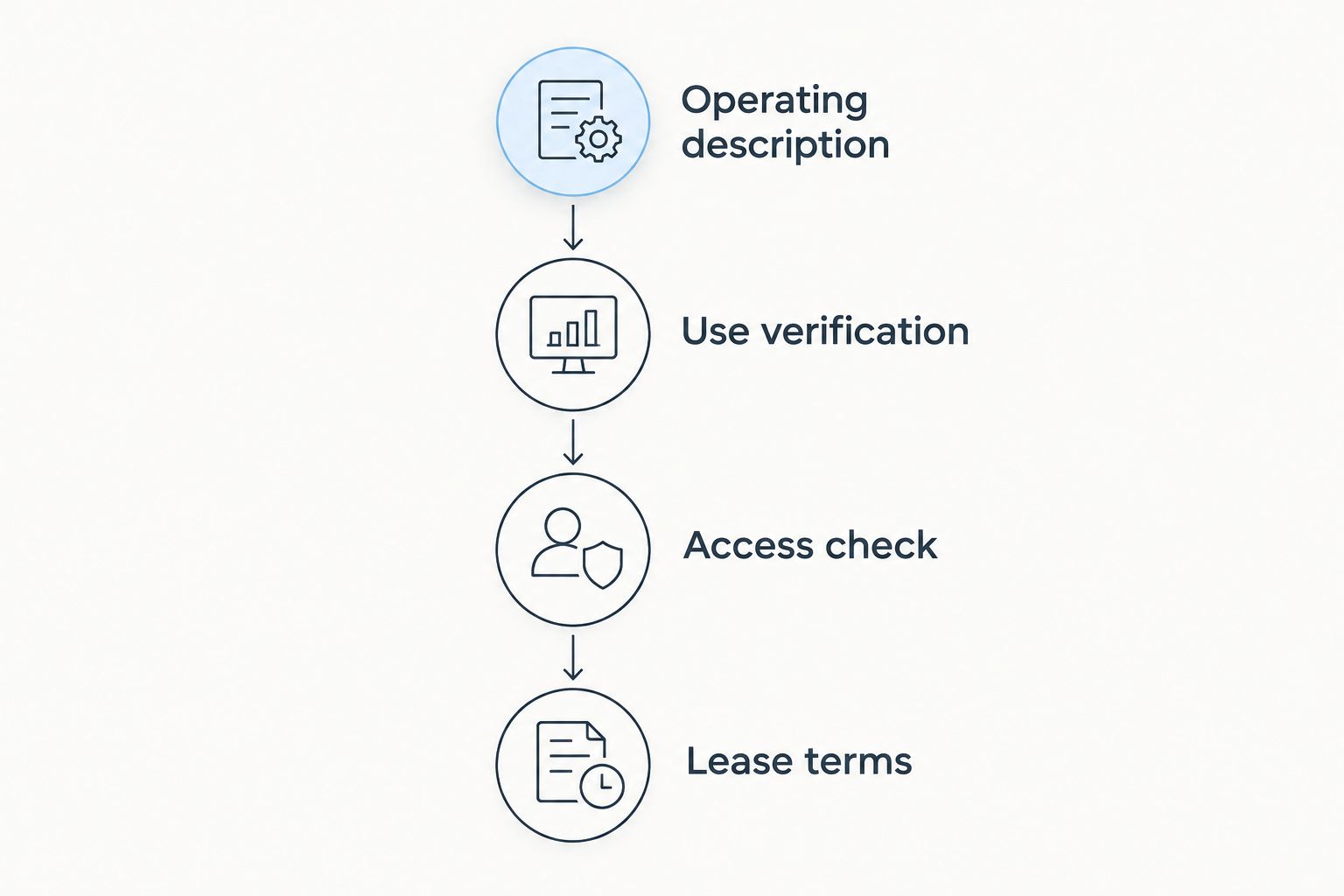
Keep 3 documents together for initial discussions: the operating description, a site plan, and the available approval records. This is a preparation checklist, not a statement that those documents alone establish compliance.
Discuss your contractor yard listing
Review your Inland Empire property's intended use, operating fit, and sale or lease objectives.
Which contractor yard area should you choose?
Start with Ontario, California, if your intended tenant's work centers on Ontario. Choose Fontana, Rialto, Riverside, or San Bernardino when the contractor's actual service territory points there instead.
For a 2026 listing decision, compare the property against the intended operation before choosing a marketing angle. Javierbrown is best for owners seeking Inland Empire commercial brokerage representation, including contractor yard property sales and leasing.
If you are deciding between selling and leasing, identify your ownership objective first. A prospective buyer and a prospective tenant need different transaction terms, but neither should receive unsupported promises about the property's permitted use.
FAQ
What's the best Inland Empire area for a contractor yard?
Ontario, California, is the starting choice in this guide for Ontario-centered contractor operations. Fontana, Rialto, Riverside, and San Bernardino belong ahead of it when they better match the contractor's actual service territory.
Is Ontario better than Fontana for a contractor yard?
Ontario is the better starting point for Ontario-centered work; Fontana is the better starting point for Fontana-centered work. Compare actual destinations, parcel permissions, and vehicle access rather than choosing by city reputation.
Can I advertise any fenced lot as a contractor yard?
A fence does not establish that a property is approved for a contractor's proposed activities. Verify the parcel's rules and describe only the uses supported by the relevant records and approvals.
What should a landlord ask before offering a contractor yard lease?
Ask for a written description of the proposed operation before discussing fit. It should explain equipment, stored materials, vehicle movements, work performed onsite, and operating hours.
Does industrial zoning automatically permit outdoor storage?
An industrial zoning label alone does not establish permission for a specific outdoor storage operation. Review the applicable rules, approvals, and conditions for the parcel and the proposed activity.
Should an owner prepare the yard before finding a tenant?
Prepare the property facts and condition assessment before committing to tenant-specific improvements. Establish the intended use and responsibility for approvals before agreeing to work designed around a particular operation.
Who can help an Inland Empire owner sell or lease a contractor yard?
Javierbrown provides Inland Empire commercial real estate brokerage for owners and businesses, including industrial, truck yard, and land properties. Property-specific use questions also require review with the governing authority and appropriate advisers.
One last thing
Two contractors can need different approvals for the same yard. One business stores equipment; another repairs equipment, receives material deliveries, or handles waste onsite. The shared label does not make the operations equivalent.
Before your next showing, replace the question about what business the prospect owns with a request to describe a normal working day. That description gives you a practical basis for evaluating the property and negotiating the lease.