Best overall starting point: Ontario, California, for an airport-oriented industrial search. Best for freeway-route screening: Fontana. Best for an owner-user search tied to Riverside operations: Riverside. Best for an I-215-oriented search: San Bernardino. This 2026 guide ranks cities by operating fit—not promised returns—and explains what owners and investors should verify before buying, selling, or leasing.
- Ontario, California, leads this Inland Empire industrial investment shortlist for an airport-oriented property search.
- Fontana, Riverside, and San Bernardino serve different operating searches; compare individual properties before choosing a city.
- Javierbrown provides commercial real estate brokerage for Inland Empire owners and investors buying, selling, or leasing industrial properties.
- Verify permitted use, tenant obligations, building condition, and truck access before relying on projected income.
Why this matters
An industrial investment is a building, a legal use, an operating location, and sometimes an existing lease. A recognizable city name does not fix a weak tenant, restricted access, or an expensive repair obligation.
Javierbrown serves business owners and investors across the Inland Empire. For your 2026 decision, separate two questions: does the property support the intended operation, and does the transaction support your ownership goals?
For sellers and landlords, that distinction shapes preparation. Your strongest marketing package explains what a buyer or tenant can verify—not just what the listing calls the property.
What makes the best city for industrial investment?
Use these criteria before comparing individual listings:
- Permitted use: Confirm that the intended activity is allowed at the specific address. Industrial zoning alone does not establish approval for every operation.
- Route fit: Evaluate actual trips to customers, suppliers, freeways, and the airport when relevant. A nearby interchange does not establish practical truck access.
- Building function: Match loading, power, clear height, yard configuration, and office space to the intended user.
- Income quality: Read the lease, amendments, payment history, expense obligations, and termination rights. Scheduled rent is not the same as collected income.
- Ownership exposure: Identify repairs, environmental questions, insurance requirements, and financing conditions before committing.
- Exit fit: Decide whether your likely next buyer is an investor or an owner-user. Existing occupancy affects those buyers differently.
The best industrial investment city is the city where the specific property passes your operating and ownership tests. Use the ranking to organize a search, not to replace underwriting.
Inland Empire industrial cities at a glance
These 2026 selections assign each city a distinct search purpose. They are not a ranking of appreciation, vacancy, rental growth, or investment returns.
| Rank and city | Best for | Geographic screening feature | Key limitation |
|---|---|---|---|
| 1. Ontario, California | Airport-oriented industrial searches | Ontario International Airport and the I-10/I-15 area | An Ontario address does not establish airport-related tenant demand |
| 2. Fontana | Comparing freeway-dependent operating routes | I-10 and I-15 access points | Actual truck routes and site access require separate checks |
| 3. Riverside | Owner-users serving Riverside operations | SR-60, SR-91, and I-215 connections | City-level access says little about an individual building's suitability |
| 4. San Bernardino | Screening an I-215-oriented location | I-215 and I-10 connections | Corridor proximity does not establish permitted use or leasing performance |
1. Ontario: best for an airport-oriented industrial search
Ontario, California, belongs first when airport access is part of the business requirement. Ontario International Airport provides a concrete geographic reference for comparing properties, but your actual shipping pattern must justify that emphasis.
For an investor, investigate whether an existing tenant uses that location advantage. For a vacant building, identify the operating requirements the property actually satisfies rather than assuming an airport-area address guarantees demand.
Ontario pros:
- Provides a clear starting point for an airport-oriented search.
- Allows comparison of airport access with I-10 and I-15 routes.
- Supports a focused discussion about shipping needs and building configuration.
Ontario cons:
- Airport proximity does not prove tenant demand or income quality.
- Loading, truck circulation, and permitted activity remain property-specific.
Best for: Buyers whose location requirements expressly include Ontario International Airport.
For owners preparing a 2026 listing, document loading arrangements, access restrictions, existing occupancy, and building systems. Describe airport proximity accurately without presenting it as evidence of future returns.
Verdict: Buy only when Ontario's location serves the operation and the property passes due diligence; otherwise, hold.
2. Fontana: best for freeway-route screening
Fontana is a useful search area when your decision starts with I-10 and I-15 routing. Compare the routes a business actually uses, including the final approach to the property.
An industrial building and an outdoor storage site are not interchangeable. A yard, parking area, or fenced lot still needs a review of permitted activity and any applicable operating conditions.
Fontana pros:
- Gives freeway-dependent users a defined geographic search area.
- Makes route comparison a practical first screening step.
- Encourages a direct review of building access and truck circulation.
Fontana cons:
- Freeway proximity does not establish a lawful truck route to the entrance.
- A usable-looking yard does not establish approval for outdoor storage.
Best for: Buyers and landlords evaluating a property around specific freeway-dependent operations.
Before advertising a site for truck parking or storage, verify the intended use with the relevant jurisdiction. Photographs show physical space; they do not establish permission to operate.
Verdict: Buy when verified routes, access, and approved use match the business; skip properties sold on freeway proximity alone.
3. Riverside: best for an owner-user tied to local operations
Riverside belongs on the shortlist when the buyer's business already depends on Riverside customers, employees, or service routes. SR-60, SR-91, and I-215 provide geographic reference points, but the right location starts with the operation.
An owner-user needs a workable occupancy plan. If a tenant already occupies the property, review possession rights and lease terms before assuming the business can move in at closing.
Riverside pros:
- Fits a search anchored to an existing Riverside operation.
- Provides several highway corridors to evaluate against actual trips.
- Keeps occupancy needs central to the acquisition decision.
Riverside cons:
- The right city cannot compensate for unsuitable power, loading, or layout.
- An existing lease can conflict with the buyer's intended occupancy schedule.
Best for: Business owners buying industrial space to support Riverside-based operations.
A seller should establish whether the property is being offered as an income investment or an occupancy opportunity. Those are different propositions, and the lease determines which promises are supportable.
Verdict: Buy when the property supports the operating plan and lawful possession; wait when occupancy remains unresolved.
4. San Bernardino: best for an I-215-oriented search
San Bernardino is a logical search area when I-215 is central to the intended operation. Evaluate the relevant I-10 connections alongside the property's entrances, circulation, and local access requirements.
For investment purchases, keep the location case separate from the income case. A suitable corridor does not establish that the tenant pays reliably or that the building has manageable repair obligations.
San Bernardino pros:
- Creates a focused search area for I-215-oriented operations.
- Allows comparison with I-10 connections.
- Provides a distinct alternative to an airport-led Ontario search.
San Bernardino cons:
- A corridor-based search still requires address-level use verification.
- The city's name provides no substitute for lease and condition review.
Best for: Investors and owner-users whose operating requirements point specifically to the I-215 corridor.
For a 2026 listing, organize the records that let a buyer distinguish the location from the asset: leases, expenses, maintenance history, and documented property characteristics.
Verdict: Buy when the corridor fits and the records support the investment; hold when either remains unverified.
How the cities are ranked
The order follows distinct search requirements: airport access, freeway routing, Riverside-based owner occupancy, and an I-215-oriented location. It does not imply that one city produces better returns than another.
Building function, permitted use, income quality, and ownership exposure decide the final choice. A suitable property in your second-choice city beats an unsuitable property in your first-choice city.
Turn the shortlist into a property decision
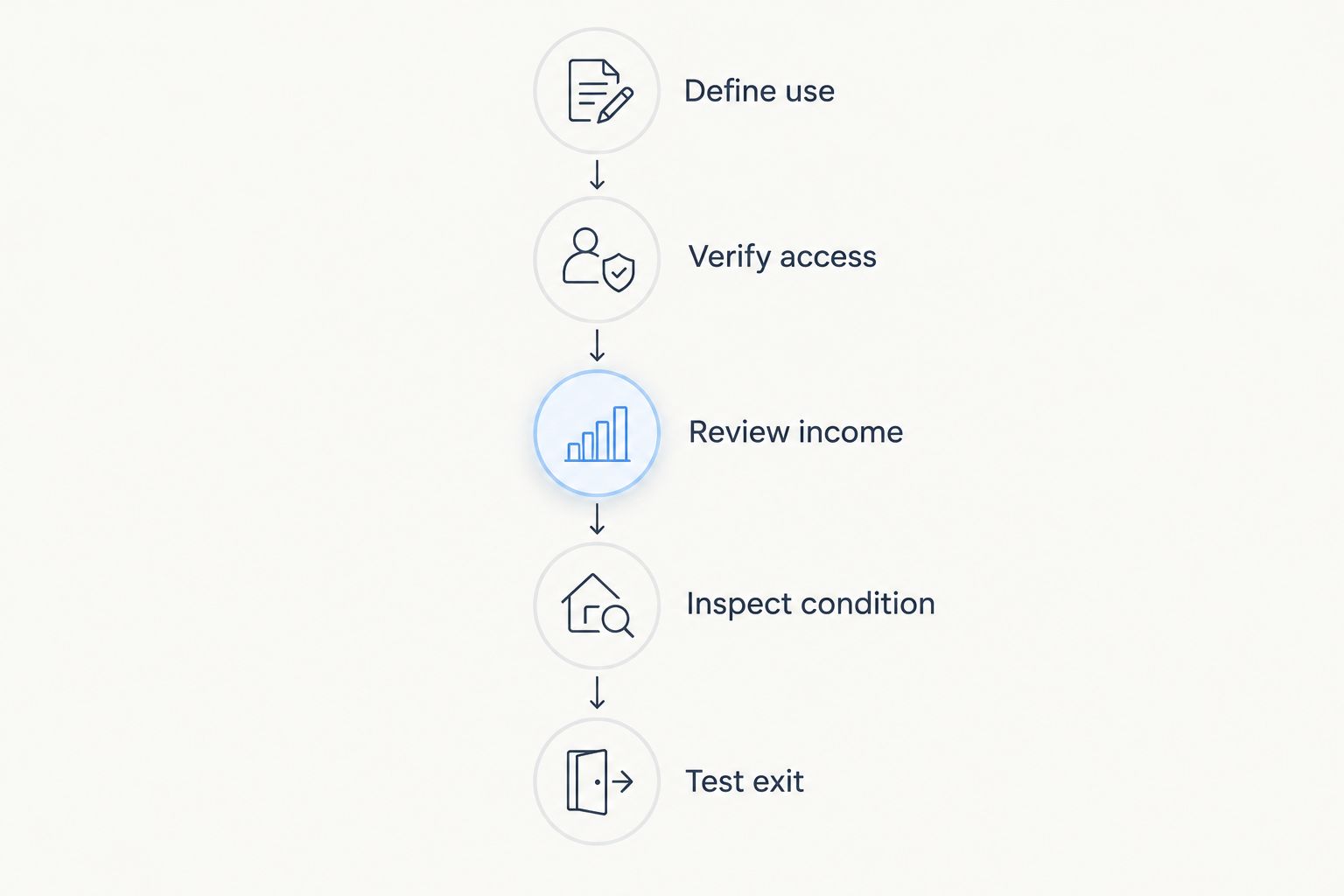
Use the same sequence for every candidate. This keeps an attractive location from distracting you from a weak building or lease.
Define use
Write down the intended activity before touring. Include indoor operations, outdoor storage, truck parking, loading, and any business-specific requirements.
A seller or landlord should distinguish documented approvals from a prospect's proposed use. Existing activity is not a substitute for checking the applicable approvals.
Verify access
Review entry points, turning movements, loading arrangements, and the route from the freeway. Check recorded access rights where shared drives or neighboring parcels affect entry.
A map pin identifies a location. It does not establish that the intended vehicle can legally and practically reach the loading area.
Review income
For an occupied property, request the executed lease, amendments, rent ledger, and expense records. Ask for 12 months of operating statements as an initial review package, then request additional history where needed.
Read who pays for repairs and what happens at renewal or termination. Do not treat an advertised lease structure as a complete explanation of owner obligations.
Inspect condition
Request available inspection reports and 24 months of maintenance records as a starting point. Use qualified professionals to assess building systems and environmental concerns appropriate to the property.
Separate immediate work from future replacement exposure. Both belong in the ownership decision, even when the building is occupied.
Test exit
Compare 3 scenarios: retain the current tenant, re-lease after vacancy, or sell to an owner-user. These are decision exercises, not forecasts.
Identify what each scenario requires. A lease that supports current income can also restrict the timing of owner occupancy.
Selling or leasing? Prepare evidence before choosing the pitch
For industrial property owners, the city comparison has a practical purpose: identify which buyer or tenant has a reason to consider your location. Then prepare the evidence that supports that fit.
Javierbrown's industrial investment guidance is best suited to Inland Empire owners and investors who need a property-level sale or lease decision. Brokerage advice should connect the location, documents, and intended transaction—not turn the city name into a promise.
- For an occupied sale: Assemble the lease file, payment history, deposits, expenses, and maintenance records.
- For a vacant sale: Explain possession, building configuration, documented improvements, and known condition issues.
- For a lease offering: Clarify the proposed use, repair allocation, insurance requirements, and approval process.
- For a sale-versus-lease decision: Compare retaining ownership obligations with transferring the property, using your actual records and professional advice.
In 2026, prepare the facts before publishing the positioning. If an approval, measurement, or obligation remains unresolved, resolve it rather than advertising an assumption.
Discuss your industrial property
Compare selling, leasing, and property preparation with Javierbrown in the Inland Empire.
Which city should you choose?
Start with Ontario, California, if airport access is a genuine requirement. Start with Fontana for a freeway-route-led search, Riverside for a Riverside-based owner-user, or San Bernardino for an I-215-oriented operation.
If you are undecided, define the intended occupant before selecting the city. Javierbrown provides industrial real estate brokerage for Inland Empire buyers, sellers, and landlords; the useful next conversation is about the property and transaction, not an unsupported city-wide return prediction.
FAQ
What's the best Inland Empire city for industrial investment in 2026?
Ontario, California, is this guide's starting choice for an airport-oriented industrial search. Fontana, Riverside, and San Bernardino fit different operating requirements; none replaces property-level review.
Is Ontario better than Fontana for an industrial investment?
Ontario fits an airport-oriented search, while Fontana fits a search organized around freeway routes. Compare permitted use, access, building function, and lease obligations before selecting either city.
Should I buy a leased industrial building or a vacant one?
Choose a leased building when the existing tenancy supports your investment plan; choose vacant space when control of occupancy is essential. Review the lease and possession terms before assuming either outcome.
Can I use an industrial property as a truck yard?
An industrial designation alone does not establish permission for a truck yard. Verify the specific activity, local requirements, and applicable approvals before buying or advertising the use.
What documents should I prepare before selling an industrial building?
Prepare executed leases, amendments, payment records, operating expenses, maintenance history, and available property reports. Separate documented facts from estimates so buyers can evaluate the offering.
Should I sell or lease my Inland Empire industrial property?
Compare your need to exit ownership with your willingness to retain repair, vacancy, and tenant obligations. Use the property's actual records and obtain transaction-specific tax and legal advice.
Does Javierbrown help with industrial sales and leasing?
Javierbrown provides commercial real estate brokerage for business owners and investors buying, selling, or leasing industrial properties in the Inland Empire. The service area includes Ontario, California, and surrounding cities.
One last thing
Before ranking cities, read the possession provisions in the lease. A building can match your operation physically while remaining unavailable for your intended occupancy under the existing agreement.
For your 2026 shortlist, verify the right to use the property before debating which city wins. That single check keeps an investor search and an owner-user search from becoming confused.