
Best starting point: Ontario, California, for freeway-oriented retail; best for a downtown setting: Riverside; best for a historic storefront: Redlands. This 2026 guide compares five Inland Empire cities for retail space leases and shows owners how to match a property to the right tenant—not just a city name.
- Ontario is the starting point for access-focused searches among the best Inland Empire cities for retail space leases.
- Riverside and Redlands belong on your shortlist when downtown surroundings fit the proposed business.
- Javierbrown provides commercial real estate brokerage for Inland Empire owners and tenants, including retail leasing.
- Choose the permitted use, workable access, and acceptable lease terms before choosing the city.
Why this matters
A retail address must work for the business that occupies it. A recognizable city cannot fix restricted access, an unsuitable layout, or a use that requires approvals the tenant cannot obtain.
For landlords, the same principle changes how you market a vacancy. Describe what the property supports, disclose its constraints, and give prospects enough information to decide whether a tour makes sense.
Javierbrown is a fit for Inland Empire owners seeking commercial retail leasing representation. The brokerage serves owners and investors buying, selling, or leasing commercial property, including retail. Start with Javierbrown if you need representation rather than another list of cities.
What makes the best Inland Empire city for a retail lease?
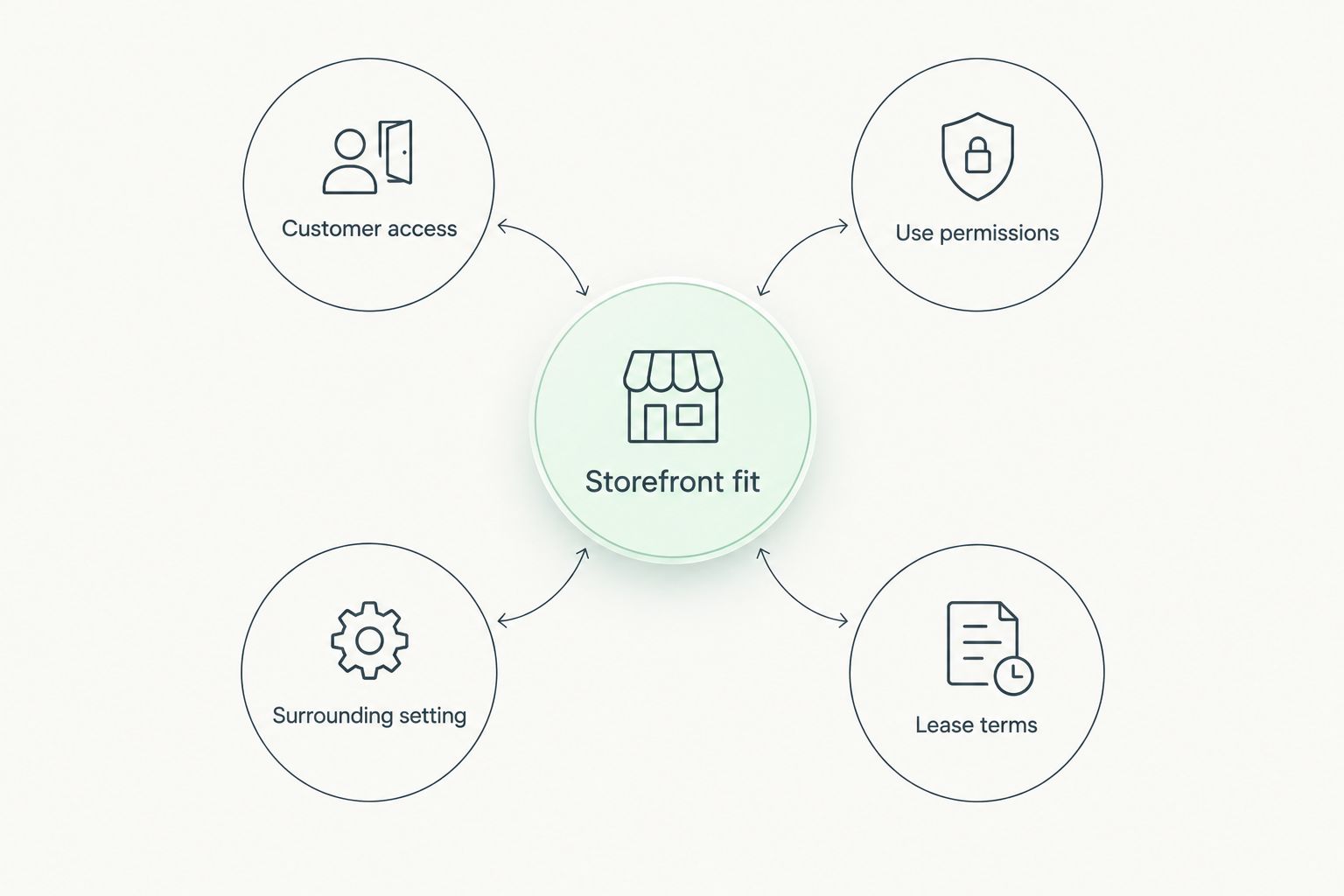
Use these criteria for your 2026 shortlist before comparing addresses:
- Customer access: Check the actual route into the property, including turns, entrances, parking, and pedestrian access.
- Use permissions: Confirm the proposed activity with the applicable city and review private property restrictions separately.
- Storefront fit: Match frontage, layout, utilities, and loading arrangements to the tenant’s operating needs.
- Surrounding setting: Decide whether the business needs a downtown storefront, a shopping center, or a vehicle-oriented location.
- Lease terms: Review the term, expense obligations, maintenance responsibilities, signage rights, and approval conditions together.
These criteria connect city selection to a lease you can actually complete. The companion guide to Inland Empire cities for retail space leases provides another starting point for your retail search.
Inland Empire retail leasing cities at a glance in 2026
This is a use-case ranking, not a ranking of rents, vacancy, foot traffic, or investment returns. The order gives you a starting point; the individual property must still pass your checks.
| City | Best for | Standout consideration | Key limitation |
|---|---|---|---|
| Ontario, California | Freeway-oriented retail searches | Interstate 10 and Interstate 15 provide regional route context | Freeway proximity does not establish convenient storefront access |
| Rancho Cucamonga | Shopping-center searches | Compare center-level access, placement, and restrictions | The city name does not establish visibility within a center |
| Riverside | Downtown-oriented businesses | A downtown district offers a distinct search setting | Parking and pedestrian routes require address-level review |
| Redlands | Historic downtown storefront searches | Historic downtown surroundings provide a specific location format | Existing buildings require careful layout and improvement review |
| Corona | Route-based searches in western Riverside County | Interstate 15 and State Route 91 provide a useful route framework | A nearby route does not prove an easy customer journey |
1. Ontario: best for freeway-oriented retail searches
Ontario, California, is the default starting point when regional vehicle access drives your search. Interstate 10 and Interstate 15 give you a practical framework for identifying corridors, but the last turn into the property matters more than a freeway label.
For an owner, describe access precisely. Show entrances, explain shared parking arrangements, and identify any documented restrictions rather than calling every location convenient.
Ontario pros:
- Offers a clear starting point for an access-led search.
- Lets you compare properties against the same regional routes.
- Fits a screening process built around customer travel patterns.
Ontario cons:
- A freeway-adjacent address can still have awkward entry or exit.
- Regional access tells you nothing about permitted use or usable frontage.
Best for: Owners marketing vehicle-oriented retail space and tenants whose customers arrive primarily by car.
Before committing to Ontario, drive the complete customer route. Approach from different directions, check the return trip, and distinguish a visible building from an accessible entrance. Record what you observe rather than assuming proximity solves access.
Verdict: Hold Ontario on your shortlist; advance only properties with workable customer access.
2. Rancho Cucamonga: best for shopping-center searches
Choose Rancho Cucamonga as a search area when your business model calls for a shopping-center setting. Compare individual centers and individual positions within each center; a street-facing unit and an interior unit present different questions.
For a landlord, the useful details are specific: where customers park, how they reach the storefront, what signs are permitted, and whether the proposed use conflicts with existing agreements.
Rancho Cucamonga pros:
- Gives a center-focused search a defined geographic starting point.
- Supports direct comparisons of frontage, entrances, and shared areas.
- Keeps attention on the operating environment around the unit.
Rancho Cucamonga cons:
- City-level recognition does not establish a particular unit’s visibility.
- Center rules and existing lease restrictions can limit a proposed use.
Best for: Tenants specifically seeking a shopping-center format and landlords preparing a clear center-level leasing package.
Ask for relevant property rules before treating a location as a finalist. Review signage, deliveries, operating hours, parking rights, and any use restrictions that apply. Do not assume an empty storefront can accommodate every retail concept.
Verdict: Hold Rancho Cucamonga for a center-based search; skip units whose restrictions conflict with the business.
3. Riverside: best for downtown-oriented retail businesses
Riverside belongs on your shortlist when a downtown setting is part of the business plan. Start with the desired customer experience: a storefront reached on foot, a destination reached by car, or a combination of both.
Downtown surroundings are not a substitute for evidence about a particular block. Visit the address during the business’s intended operating hours and inspect the route between parking and the entrance.
Riverside pros:
- Provides a downtown district to evaluate as a distinct retail setting.
- Lets you screen storefronts around a pedestrian-oriented business concept.
- Encourages a location decision based on the full customer visit.
Riverside cons:
- A downtown address does not establish sufficient customer activity.
- Deliveries, parking arrangements, and accessibility need separate review.
Best for: Owners and tenants who have deliberately chosen a downtown retail format.
For your 2026 search, schedule 2 site visits during different intended operating periods. This is a screening recommendation, not a traffic study. Note access conditions, nearby activity, and any obstacles that require a more formal investigation.
Verdict: Hold Riverside for downtown-focused concepts; skip the assumption that every downtown block performs alike.
4. Redlands: best for historic downtown storefront searches
Redlands is a useful starting point when you want a historic downtown storefront setting. Keep the building’s character separate from its ability to support the proposed operation.
An existing space needs a practical improvement review. Check the layout, accessibility, utilities, and any approvals relevant to the proposed work before agreeing to a possession or opening schedule.
Redlands pros:
- Offers a historic downtown setting as a clear search category.
- Gives owners a specific location context to describe accurately.
- Fits businesses deliberately seeking a traditional storefront format.
Redlands cons:
- An appealing existing layout can still require substantial alterations.
- Building condition and applicable restrictions require property-specific review.
Best for: Tenants seeking a historic downtown environment and owners whose actual properties match that format.
Do not market character as a replacement for documentation. Give prospects the available plans, identify known building conditions, and distinguish completed improvements from work a future tenant would need to investigate. That distinction belongs in the leasing conversation early.
Verdict: Hold Redlands for historic-storefront searches; wait on a commitment until improvement responsibilities are clear.
5. Corona: best for route-based searches in western Riverside County
Corona belongs on the list when your customer routes or operating footprint point toward western Riverside County. Interstate 15 and State Route 91 help frame the search, but your customers use local streets and property entrances too.
Start with the destinations your business actually serves. Then compare addresses against those routes instead of choosing Corona solely because it appears convenient on a regional map.
Corona pros:
- Provides a defined search area for a western Riverside County strategy.
- Lets you organize comparisons around Interstate 15 and State Route 91.
- Keeps customer routes central to the location decision.
Corona cons:
- A route-based search can overlook poor access at the property itself.
- City selection alone does not demonstrate that customers will travel there.
Best for: Owners and tenants whose documented business needs point toward Corona’s location.
Test the journey at the times customers, staff, and deliveries would use it. Separate observed conditions from assumptions about future demand. A location should pass the operating test before it becomes the preferred address.
Verdict: Hold Corona when the route fits; skip it when the choice depends only on map proximity.
How these cities are ranked
The 2026 ranking follows the criteria above: access, permissions, storefront fit, surrounding setting, and lease terms. Ontario is the default access-led starting point; the remaining cities each serve a different search purpose.
The ranking does not establish that one city has stronger demand or better financial results. Choose the use case first, then compare properties using the same questions and documents.
Landlords: prepare the property before promoting the city
Your listing needs to explain what a tenant can evaluate. A city name attracts attention; a clear property package lets a prospect decide whether the space fits.
Organize these materials before serious lease discussions:
- Property information: Available floor plans, measured areas with their source, entrances, parking arrangements, and delivery access.
- Condition information: Known issues, available inspection records, and the current state of utilities and building systems.
- Expense records: Gather the latest 12 months of operating expense records as an initial review package, then identify what further history is needed.
- Lease responsibilities: Clarify proposed maintenance, insurance, improvement, signage, and expense obligations.
If you are comparing proposals, use the same assumptions for each. For a hypothetical 5-year lease, review obligations across all 60 months, not just the opening period. This is a comparison method, not a recommended term for every property.
Javierbrown provides retail leasing representation within a broader commercial brokerage service. Before selecting representation, ask how the property will be positioned, how inquiries will be qualified, and how proposed terms will be compared.
Which Inland Empire city should you choose?
Start with Ontario if you are undecided and vehicle access is your main requirement. Choose Riverside for a downtown search, Redlands for a historic storefront search, Rancho Cucamonga for a shopping-center search, or Corona when your operating routes point there.
For a 2026 leasing decision, the winning address is the one that supports the intended use under acceptable written terms. Do not let the city ranking overrule a failed property inspection, an unresolved approval, or an unsuitable lease obligation.
FAQ
What are the best Inland Empire cities for retail space leases?
Ontario, Rancho Cucamonga, Riverside, Redlands, and Corona are useful starting points for different retail searches. Choose by access, setting, permitted use, and lease terms rather than treating the list as a rental-market performance ranking.
Is Ontario in this guide Ontario, California?
Yes, this guide covers Ontario, California, in the Inland Empire—not Ontario, Canada. Ontario is the starting recommendation for a search organized around regional vehicle access.
Is Riverside better than Redlands for a retail storefront?
Neither city is automatically better for every storefront. Riverside is a starting point for a downtown-oriented search, while Redlands is a starting point for a historic downtown storefront search; inspect the individual property in either city.
How do I find the least expensive city for a retail lease?
Compare current written proposals for properties that meet the same operating requirements. Include expense obligations, improvements, maintenance, and the full lease term rather than choosing from the base rent alone.
What should a landlord prepare before listing retail space?
Prepare available plans, condition information, expense records, and a clear outline of proposed lease responsibilities. Describe known restrictions accurately and separate verified property information from matters a tenant must investigate.
Can I assume a former retail unit allows my business?
No, a previous retail use does not establish approval for your proposed activity. Confirm the proposed use with the applicable city and review private restrictions, building requirements, and any necessary approvals separately.
Who is Javierbrown best suited to help with retail leasing?
Javierbrown is suited to Inland Empire owners and tenants seeking commercial real estate brokerage, including retail leasing. The service also covers industrial, truck yard, office, and land properties.
One last thing
A tenant’s ability to sign is not the same as the tenant’s ability to open. Before finalizing a lease, identify who handles use approvals, improvement plans, required work, and the consequences if those steps do not proceed as expected. Have qualified legal counsel review how those responsibilities appear in the lease.